How Social Comparison Drives FOMO in Feeds
Social media feeds are designed to keep you hooked by amplifying social comparison and FOMO (Fear of Missing Out). Here's how it works:
- Social Comparison: Platforms expose you to "highlight reels" of others' lives, making you compare yourself to their curated success or happiness.
- FOMO Cycle: Seeing idealized content leads to feelings of inadequacy, pushing you to share your own highlights, creating a loop of comparison and anxiety.
- Algorithm Influence: Algorithms prioritize emotionally charged posts - especially those sparking envy - to maximize engagement, often at the cost of mental well-being.
- Mental Health Impact: This constant comparison affects self-esteem, triggers emotional exhaustion, and can lead to compulsive social media use.
FOMO isn't just an emotional response - it's a system-driven outcome of how platforms are designed. Breaking this cycle means adopting intentional habits, like limiting scrolling, using chronological feeds, or switching to platforms like Fifteen that prioritize user well-being over endless engagement.
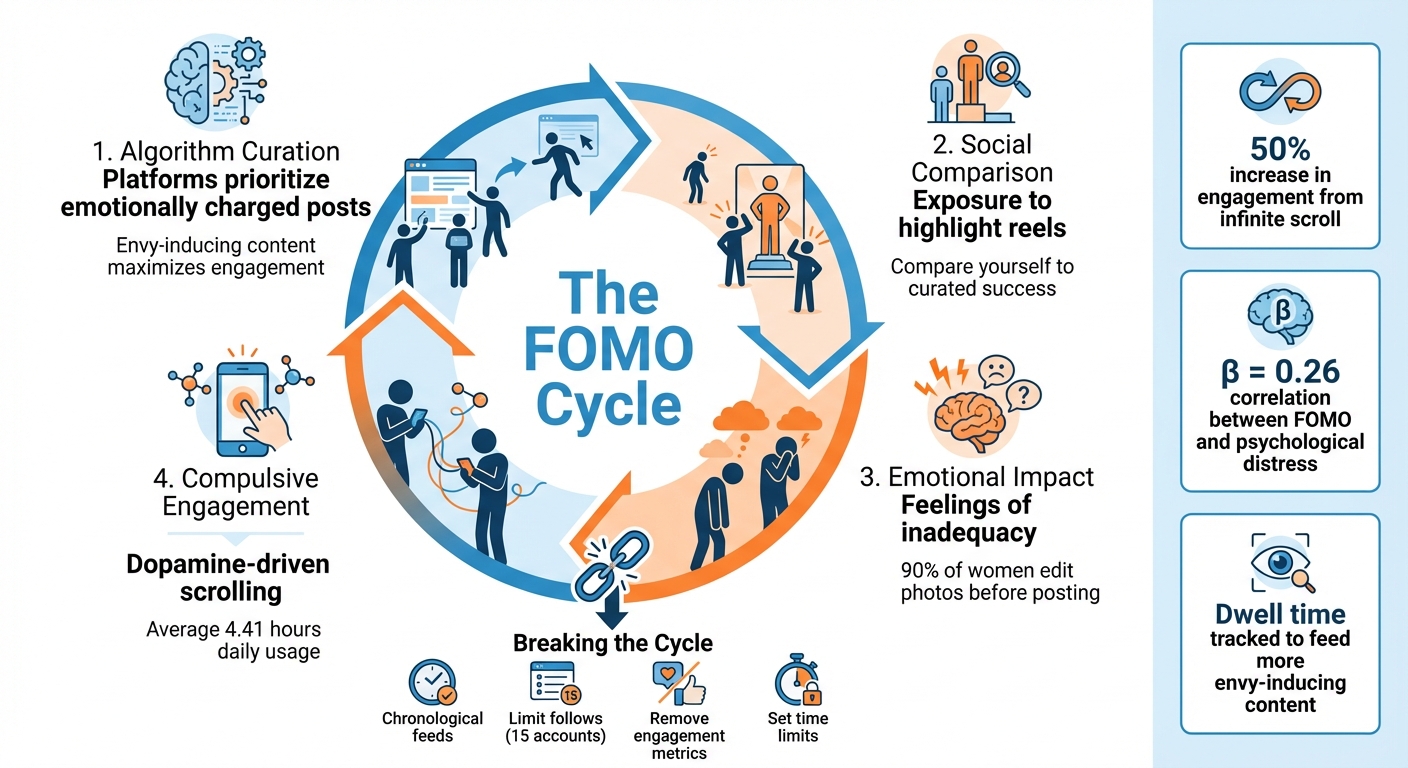
How Social Media Algorithms Drive FOMO and Social Comparison Cycle
The Problem: Social Comparison Drives FOMO in Feeds
Algorithms Amplify Upward Comparisons
Social media doesn’t just show you random posts - it carefully selects content designed to keep you scrolling. Every piece of content in your feed is ranked based on how likely it is to spark engagement, whether through likes, comments, or shares. And what grabs attention most? Emotionally charged posts, especially those that stir envy or make you feel inadequate. Platforms know these emotions keep you hooked. A 2021 study even found that posts using moral or emotional language spread much faster on social networks.
What this means for your feed is simple: it’s not real life. Instead, it’s a polished highlight reel of idealized moments. And it doesn’t stop there. Social media breaks down traditional boundaries, so you’re no longer just comparing yourself to friends or coworkers. Now, you’re measuring your life against influencers, celebrities, and strangers from around the world. This constant stream of filtered, aspirational content skews your sense of what’s "normal" or "attractive." Even the time you spend lingering on a post - known as "dwell time" - is tracked to feed you more of the same envy-inducing material. The result? A never-ending cycle of comparison that takes a real toll on mental health.
The Mental Cost of Constant Comparison
The emotional impact of constantly comparing yourself to others is undeniable. For example, 90% of women report editing their photos before posting them on social media. Why? Because every like and comment triggers your brain’s ventral striatum - the same part that lights up when you win money or eat your favorite dessert. This creates a dopamine loop, making it nearly impossible to resist checking your phone, much like the pull of a slot machine.
Notifications and likes create a dopamine cycle similar to substance addiction.
But it’s not just about the likes. Passive scrolling - endlessly consuming other people’s curated lives - can be especially harmful. The gap between the perfect version of yourself you present online and your real-life self can lead to cognitive dissonance. This disconnect fuels feelings of imposter syndrome and emotional exhaustion as you try to maintain a consistent digital persona. Over time, this can lead to viewing yourself as a product, constantly monitoring your appearance and actions for their "engagement potential." This obsession has even given rise to trends like Snapchat Dysmorphia, where people seek cosmetic procedures to look more like their filtered images.
How FOMO Drives Problematic Social Media Use
Social media doesn’t just distort your self-image - it traps you in a cycle of FOMO, or the fear of missing out. This fear pushes you to constantly check your feed, anxious about missing rewarding experiences or being left out socially. In response, users curate their own highlight reels to boost self-esteem and close the gap between their lives and what they see online.
As Matt Hussey puts it:
Insecurity drives engagement. Engagement drives profit.
Here’s how it works: the algorithm serves you aspirational content that makes you question your own life, nudging you to stay on the platform in search of validation or self-improvement. And every second you spend scrolling is monetized. Research from 2025 confirmed that frequent exposure to social media fuels upward comparisons and FOMO, leading to an even stronger drive for online self-presentation. This pressure is especially intense in networks dominated by strangers, where the need to showcase success is much higher than in friend-focused networks. The infinite scroll, combined with intermittent bursts of validation, creates a trap that hijacks your brain’s reward system, locking you into a cycle of compulsive engagement.
sbb-itb-d395ae5
The Consequences of FOMO in Feeds
Digital Hoarding and Content Overload
FOMO can turn feeds into a breeding ground for digital hoarding. When users are constantly exposed to idealized content, they feel compelled to save posts, bookmark articles, and download files - many of which they may never revisit. This behavior, known as digital hoarding, leads to an overwhelming accumulation of files that creates stress and chaos. The emotional attachment to these saved items makes it incredibly hard to let go, leaving users trapped in a cycle of disorganization.
A study involving 556 social networking site users revealed a strong connection between upward social comparison and digital hoarding. Some participants reported spending as much as 18 hours daily on social media, with an average usage of 4.41 hours. This relentless consumption often results in "media fatigue", a state of emotional burnout caused by information overload. As Konstantopoulou and Brailas from Panteion University put it:
The overload of information and the constant need to stay connected online all the time may lead to emotional exhaustion and media fatigue.
This habit of excessive saving doesn't just create clutter - it also increases stress levels and reduces productivity. For younger users, this digital chaos can amplify emotional vulnerabilities and make it even harder to stay organized.
Higher Risks for Younger Users
Younger users face even greater risks from FOMO's impact. Research focusing on individuals with mental health challenges found that higher FOMO strongly predicted increased psychological distress (β = 0.26, p < 0.001). For teens and young adults, especially those aged 21 to 23, the constant social comparisons during these formative years can worsen emotional struggles. This often leads to problematic behaviors like doomscrolling - the compulsive habit of consuming negative news - which disrupts sleep and further strains mental health.
Kim M. Caudwell, a Senior Lecturer in Psychology at Charles Darwin University, highlights the challenges of excessive social media use:
Social media use becomes a problem for people when they have difficulty controlling urges to use social media, have difficulty cutting back on use, and where the use has a negative impact on their everyday life.
These patterns show how FOMO can deeply affect younger users, making it harder for them to maintain balance and emotional well-being in their daily lives.
The Solution: Intentional Digital Habits with Fifteen
How Fifteen Reduces Social Comparison
Intentional digital habits can help break free from the cycle of comparison and FOMO. Fifteen tackles this issue by removing the triggers that lead to endless scrolling and social comparison - the very tactics algorithms use to keep users hooked. Instead of relying on unpredictable rewards, Fifteen organizes posts in chronological order. This way, you can easily catch up on new content, and once you see a post you've already viewed, you know it's time to take a break.
Aza Raskin, the creator of infinite scroll, shared his perspective on the unintended consequences of his invention:
I got caught believing that making an interface easier to use meant it was better for humanity. Instead, it was one of the first interfaces that got used not to help you, but to hold you.
By offering a finite and predictable feed, Fifteen helps curb over-consumption.
The platform also removes engagement metrics like likes and views, which often fuel unhealthy comparisons. Without these distractions, you can focus solely on the people and content that matter to you. This intentional design encourages a more mindful and distraction-free experience.
Features That Support Minimalist Consumption
Fifteen keeps things simple by limiting the number of accounts you can follow to just 15. This keeps your feed streamlined and prevents the overwhelm that comes with information overload. With fewer sources to keep up with, it's easier to stay focused and avoid falling into addictive scrolling habits.
Another standout feature is Fifteen's personal archive, where you can save articles, videos, and posts for later. Unlike traditional feeds that constantly update, this space allows you to curate content intentionally. For those who opt for the Pro plan ($7/month or $70/year), the archive includes full-text search, making it easy to find exactly what you’ve saved. This setup shifts the focus from impulsive content consumption to thoughtful curation.
How Social Media Creates Fear of Missing Out (FOMO)
Conclusion: Rethinking Feed Engagement to Reduce FOMO
Social comparison often drives FOMO, but rethinking how social media feeds are designed could help improve mental health. For instance, while infinite scroll increased user engagement by 50%, it mainly encouraged endless scrolling without addressing users' well-being.
To break this cycle, platforms need to prioritize intentional design choices that focus on well-being over engagement metrics. Features like chronological feeds, limits on following accounts, and the removal of engagement metrics can help reduce the constant comparisons that fuel FOMO. As product and UX expert Erik Fiala explains:
The challenge for the next generation of social media designers will be to create platforms that are engaging... while also prioritizing user well-being.
You don’t have to quit social media entirely to take back control. Small, intentional changes - such as switching to a chronological feed, setting time limits for app use, or unfollowing accounts that spark feelings of inadequacy - can help you reclaim your digital habits. Shifting from mindless scrolling to purposeful consumption is a powerful way to ease FOMO.
Platforms like Fifteen demonstrate what’s possible. By limiting follows, removing engagement metrics, and using chronological feeds, they reintroduce natural stopping points. This design philosophy isn’t about abandoning social media but about focusing on what truly matters.
As Matt Hussey of The Brink insightfully puts it:
The most radical move in a performance economy is not rebellion. It is tolerance - tolerating your ordinary face, your uneven progress, your unphotogenic days.
Ultimately, your feed should work for you - not the other way around.
FAQs
Why do feeds make me compare myself to others?
Social media feeds are often filled with carefully selected glimpses of other people's lives - celebrating achievements, milestones, or exciting adventures. This can spark social comparison, where you start measuring your own life against these polished "highlight reels." Seeing posts about promotions, exotic vacations, or other accomplishments might leave you feeling inadequate or experiencing FOMO (Fear of Missing Out). The contrast between these curated moments and your day-to-day experiences can chip away at self-esteem and affect mental well-being.
How can I tell if FOMO is driving my scrolling?
FOMO, or the Fear of Missing Out, might be fueling your endless scrolling, especially if you often feel anxious, inadequate, or pressured to keep up with others' polished posts showcasing achievements or exciting events. You might notice signs like compulsively checking your feed, feeling distressed, or constantly sensing that you're falling behind. This urge often stems from social comparison, which can intensify those emotions and lead to excessive time spent online. Spotting these behaviors is the first step toward using social media with more intention and balance.
What habits help reduce comparison and FOMO fast?
To cut down on comparison and FOMO, try limiting your time on social media, practicing mindfulness and gratitude, and prioritizing real-world connections. Spending less time scrolling through curated content can ease feelings of envy. Mindfulness and gratitude can help you stay grounded in the present, while building genuine, face-to-face relationships encourages a healthier mindset and makes FOMO less of an issue.
See also: 7 Signs You Need a Social Media Detox Right Now.
Break the comparison loop. Try Fifteen →