Mental Energy Drain: Insights from Cognitive Science
Feeling mentally drained by mid-afternoon? It’s not just you. Cognitive science reveals that your brain's energy is limited and heavily influenced by how you work and the habits you maintain. Here’s what you need to know:
- Your brain consumes 20% of your body’s energy despite being only 2% of your weight. Glucose fuels neurons, but they store no reserves, leading to fatigue during prolonged effort.
- Task switching is costly. Every switch forces your brain to reset, draining energy and slashing productivity by up to 40%. It takes 23 minutes to fully refocus after interruptions.
- Mental exhaustion impacts decisions. As energy fades, you lean on easier, less thoughtful choices - like judges denying parole or doctors overprescribing antibiotics late in shifts.
To preserve mental energy:
- Batch similar tasks to avoid frequent context switching.
- Work during peak focus hours, typically 2–3 hours after waking.
- Take real breaks. Social media doesn’t help - opt for nature views, short walks, or breathing exercises instead.
Your brain works best with focus and rest. Start small: mute notifications, simplify your digital environment, and tackle your most demanding tasks when your energy is highest.
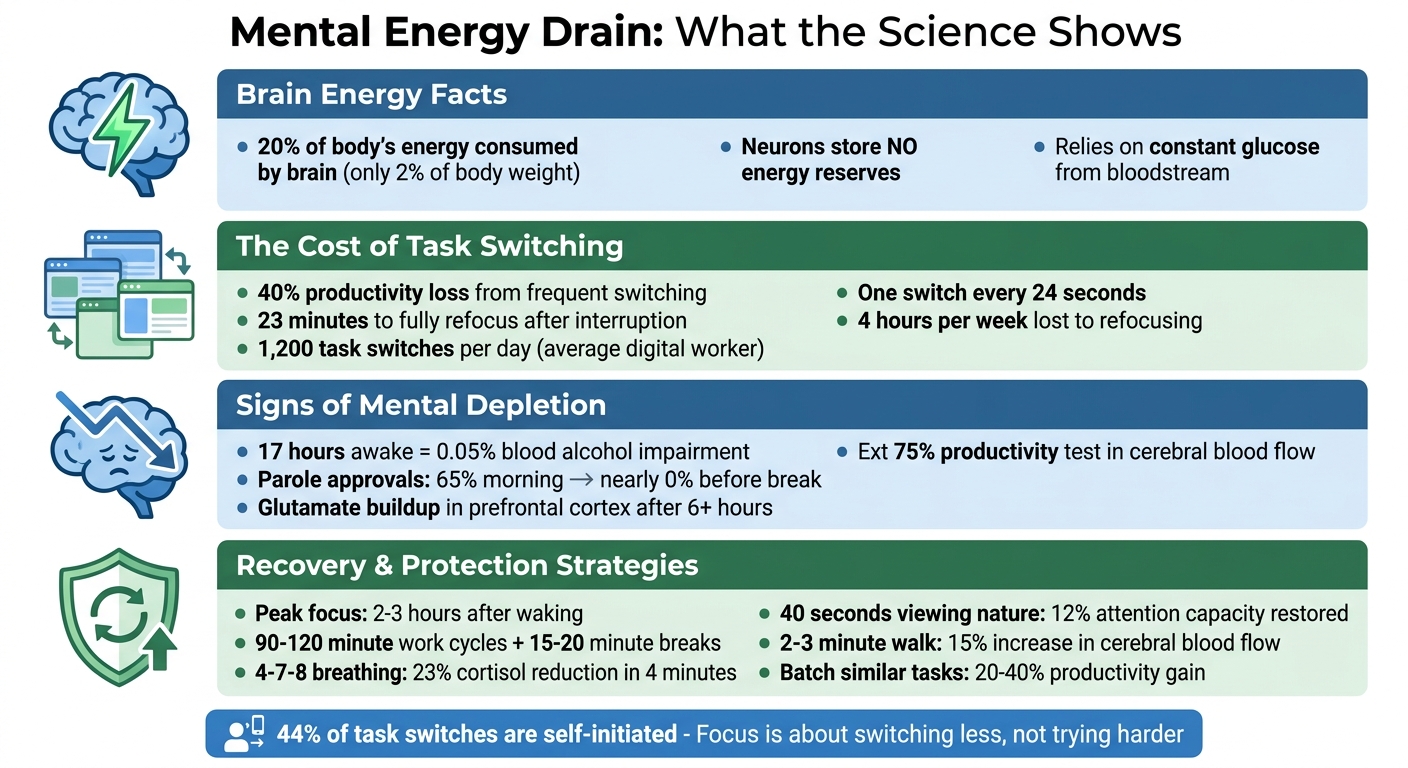
Mental Energy Depletion: Key Statistics and Recovery Strategies
How Cognitive Work Depletes Mental Energy
Brain Glucose Use During Demanding Tasks
Your brain thrives on a steady supply of glucose and oxygen to keep things running smoothly. When you're deep into a challenging task - like breaking down a dense report or making a tough decision - certain areas of your brain, particularly the prefrontal cortex, kick into overdrive and demand more energy. This region is at the heart of your executive functions, managing things like planning and decision-making.
But here's the tricky part: neurons don’t store energy for later use. They rely on a constant flow of glucose delivered directly from your bloodstream. When you push your brain hard for too long, the glucose available to your prefrontal cortex begins to drop. To cope, your brain redirects blood flow away from this high-energy-demand region toward areas responsible for more automatic, habitual responses. It’s like switching to autopilot to conserve fuel.
There’s also another challenge lurking in the background. As your neurons fire continuously during intense mental work, glutamate - the main neurotransmitter that excites your brain - starts to build up. While glutamate is essential for brain function, too much of it can be harmful. A 2022 study from the Paris Brain Institute used magnetic resonance spectroscopy to observe participants performing mentally demanding tasks for over six hours. The research revealed that glutamate accumulated in the lateral prefrontal cortex, suggesting that your brain might deliberately slow itself down to avoid potential damage from this buildup.
This combination of energy depletion and glutamate buildup explains why prolonged mental effort leaves you feeling drained - and why switching tasks can make things even worse.
Why Context Switching Drains Energy Faster
When your mental energy is already running low, switching tasks can make the situation worse. Sustained focus depletes glucose, but context switching adds another layer of strain by forcing your brain to reset and recalibrate repeatedly.
Switching tasks isn’t as simple as flipping a switch. It’s a two-step process that involves your prefrontal cortex. First, it needs to "shift goals", which means shutting down the rules and priorities of the current task. Then, it has to "activate rules", or load the framework required for the new task. Both of these steps are energy-intensive, and as you switch back and forth, the efficiency of this process starts to decline.
A 2024 study by Microsoft Research tracked 625 knowledge workers and used biomarkers to measure stress levels. The findings were eye-opening: there was a strong correlation (r=0.67) between frequent context switching and increased cortisol levels in the afternoon. This proves that task switching isn’t just mentally exhausting - it also triggers a physiological stress response. On average, knowledge workers now switch tasks every three minutes, racking up anywhere from 50 to over 80 switches per day. Each one chips away at your mental reserves, often faster than sticking with a single, focused task would.
sbb-itb-d395ae5
What Happens When Mental Energy Runs Low
Fatigue After Mental Exertion and Slow Recovery
When mental energy dips, it takes a toll on your ability to plan, prioritize, and remember - what experts call "impoverished executive function". Essentially, your brain shifts gears, conserving effort by relying on automatic, surface-level responses instead of deeper, more deliberate thinking. You might find yourself rereading the same paragraph multiple times or forgetting what you were just working on. These behaviors aren’t just random - they’re your brain’s way of protecting itself from potential harm caused by glutamate buildup and metabolic strain.
Recovering from mental exhaustion doesn’t happen quickly. For example, staying awake for 17 hours can impair cognitive performance to the same degree as having a blood alcohol concentration of 0.05% - a level that’s legally impairing in many U.S. states. And if you think a quick social media scroll will help, think again. Activities like that can keep your prefrontal cortex working harder, draining even more of your brain’s glucose reserves.
Effects on Decision Making and Motivation
As your mental energy fades, the connection between the prefrontal cortex (responsible for decision-making) and the brain’s reward center weakens. This shift pushes you toward easier, more immediate choices.
"You're not losing the ability to think. You're losing the willingness to think. The underlying neural processes remain intact. But the motivational system that powers it is winding down."
- AJ Keller, CEO, Neurosity
This dynamic can have serious consequences. A study showed that judges were far less likely to approve parole as the day wore on - parole approvals dropped from about 65% in the morning to nearly zero before a break. Similarly, research in the Journal of Patient Safety found that primary care doctors were more likely to prescribe unnecessary antibiotics later in their shifts, choosing a shortcut over the effort of educating patients.
When your brain is running on empty, it opts for the easiest route - often at the cost of thoughtful, well-considered decisions. These patterns highlight the importance of managing mental energy effectively, a topic explored further in the next section.
How to Manage and Preserve Mental Energy
Pacing Your Mental Work
Grouping similar tasks together can help your brain stay in the same cognitive "mode", cutting down on the energy lost from constantly switching gears. For instance, handling emails, coding, or administrative tasks in batches avoids the mental cost of tearing down and rebuilding focus. In fact, frequent task switching can reduce productivity by as much as 20–40%.
Timing is another critical factor. Your mental energy peaks during the first 2–3 hours after waking, making this the ideal window for tackling your most challenging work. Blocking off these peak hours for focused work and noting your progress before switching tasks can save up to 80% of the time it takes to re-engage later.
Your brain also operates on ultradian rhythms - cycles of 90–120 minutes of focus followed by a 15–20 minute break. Ignoring these natural cycles can lead to diminishing returns. Interestingly, many digital workers switch contexts up to 1,200 times a day, which only adds to cognitive fatigue.
Reducing Distractions and Simplifying Digital Consumption
The environment you work in has a bigger impact on your focus than sheer willpower. Disabling unnecessary notifications and moving communication apps out of sight can minimize distractions, especially since 44% of task switches are self-initiated. Switching between applications alone can drain about 9.5 minutes of productive flow per interruption.
"Focus is not about trying harder. It is about switching less."
- Cognitive Insight Lab
Simplifying your digital consumption is just as important. By curating what you consume online, you reduce the cognitive load on your brain. For instance, Fifteen offers a unique approach by allowing users to follow only 15 sources - be it YouTube channels, Substack writers, Medium authors, or RSS feeds. This setup creates a clean, chronological feed without ads, algorithms, or engagement traps. By cutting down on digital noise, you free up mental bandwidth for deeper focus and allow for more effective recovery during breaks.
Making Time for Rest and Recovery
To truly recover, your brain’s prefrontal cortex needs to disengage. Scrolling through social media during breaks doesn’t give your brain the rest it needs. Instead, techniques like the 4-7-8 breathing method - inhale for 4 counts, hold for 7, and exhale for 8 - can lower cortisol levels by 23% in just 4 minutes. Even a quick 40-second look at natural scenery can restore 12% of your directed attention capacity.
Incorporating brief physical movements, like a 2–3 minute walk or stretch between tasks, increases cerebral blood flow by 15%, helping to clear lingering mental activity. Despite these strategies, sleep remains the ultimate way to clear adenosine, a byproduct of mental exertion that builds up during the day. These recovery practices not only recharge your mind but also set the stage for better digital habits, which will be explored further in the next section.
Why Brain Hates Constant Task Switching: Deep Focus Explained
Conclusion: Building Better Digital Habits for Cognitive Health
Your brain isn’t built to handle the constant interruptions and noise that come with modern digital work. Every notification, tab switch, or quick check of your phone chips away at your mental energy. On average, digital workers switch between apps and websites 1,200 times a day - that’s one switch every 24 seconds - and lose almost 4 hours each week just trying to refocus after these transitions.
The answer isn’t to work harder but to reshape your environment to minimize distractions. Start by eliminating triggers that lead to unnecessary context switching. Mute non-critical notifications, group similar tasks together, and jot down quick notes to make it easier to pick up where you left off. These simple changes can help you reclaim the energy lost to constant interruptions.
It’s not just your workspace that matters - what you consume online also plays a role in your cognitive health. Simplifying your digital diet is just as important. Tools like Fifteen help by limiting your feed to just 15 curated sources, such as YouTube channels, Substack newsletters, or blogs you trust. Without algorithms, ads, or endless engagement traps, you avoid the micro-decisions and novelty triggers that scatter your attention. This intentional approach lets you focus your mental energy on what truly matters.
Take action now to regain control over your focus. Start small: batch your emails into two dedicated time slots, keep your phone out of sight during deep work, or simplify your online content with a curated feed. Even one change can make a noticeable difference in your productivity and focus.
"The brain that focuses on one thing, deeply and completely, will always outperform the brain that tries to do everything at once." - Neurosity
FAQs
How can I tell if I’m mentally fatigued or just bored?
Mental fatigue can manifest in several ways: a drop in motivation, difficulty concentrating, slower thought processes, and even irritability. Boredom, however, tends to feel more like disinterest without the same mental hurdles. To tell them apart, consider whether your ability to think and perform mentally feels compromised.
What’s the fastest way to recover focus after an interruption?
The fastest way to get your focus back is by trying strategies like task batching or time blocking. These approaches cut down on constant context switching, which can drain your mental energy. By grouping similar tasks or setting aside specific time slots for focused work, you can limit distractions and get back into a productive flow more efficiently.
Which breaks actually restore mental energy during the workday?
Taking breaks that restore mental energy can make a big difference in productivity. One approach is task batching, where you group similar tasks together. This reduces context switching, helping you stay focused and efficient. Another way to recharge is by taking breaks that let your brain reset. While the sources don’t specify exact types of breaks, the idea is to step away momentarily to refresh your mental clarity.
Protect your mental energy. Try Fifteen →
See also: Fast vs. Slow Thinking in Decisions — the mental energy behind those choices.