Priming Your Mind for Deep Reading
Struggling to focus while reading? You're not alone. The average attention span is now just 47 seconds, and distractions like TikTok can drop your memory function by 39%. Deep reading - fully immersing yourself in a text - can help you regain focus, improve comprehension, and strengthen critical thinking.
Here’s how to prepare your mind for deep reading:
- Eliminate distractions: Remove phones, notifications, and clutter. A "phone quarantine" boosts focus.
- Set clear goals: Define why you're reading to stay engaged and purposeful.
- Skim first: Preview headings, summaries, and visuals to create a mental roadmap.
- Connect knowledge: Link new ideas to what you already know for better retention.
- Read deeply: Slow down, take notes, and pause to reflect for meaningful understanding.
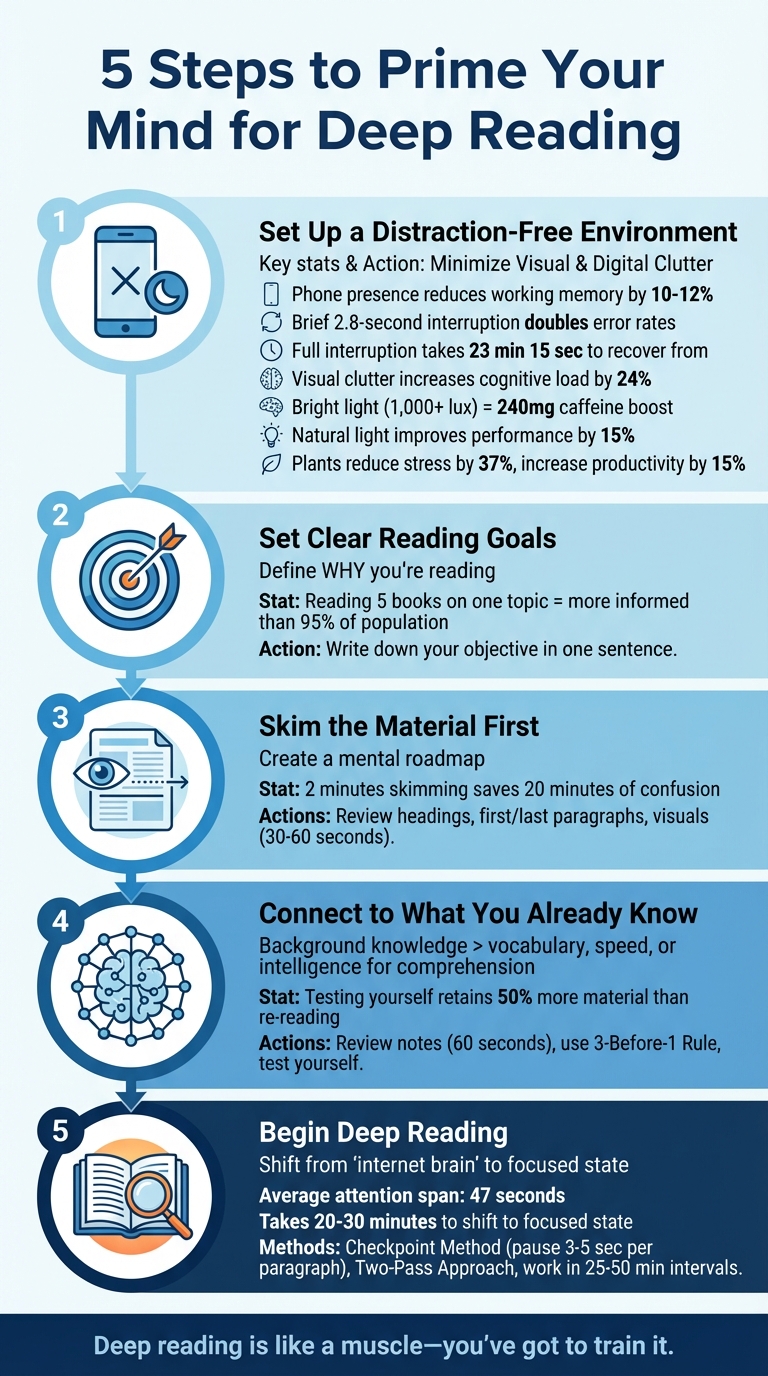
5-Step Process to Prime Your Mind for Deep Reading
Deep Reading | Maryanne Wolf
sbb-itb-d395ae5
Step 1: Set Up a Distraction-Free Environment
Your surroundings have a huge impact on your ability to focus. Trying to read while your phone buzzes nearby or notifications keep popping up is like swimming against a strong current. Research shows that even a brief interruption - just 2.8 seconds - can double error rates on cognitive tasks, and a full interruption takes an average of 23 minutes and 15 seconds to recover from.
The goal isn’t just to silence distractions but to remove them entirely from your space. This includes both digital and physical distractions, so you can fully immerse yourself in your reading.
Remove Digital Distractions
Even when silent, a phone can reduce your working memory capacity by 10–12%. Your brain works overtime just to ignore its presence. The best solution? A "phone quarantine." Place your phone - and any other distracting devices like tablets, laptops, or smartwatches - in another room while you read. Don’t just flip it over or set it on silent; get it out of sight.
If you’re reading digitally, keep it simple. Tools like Fifteen can help by providing a clean, distraction-free reading experience with no ads, algorithms, or unnecessary features. Before you start, turn off all push notifications, use app blockers, and enable "Do Not Disturb" mode. If you’re reading on a computer, close all tabs except the one you need. Research shows that single-tasking can make you up to 40% more productive than multitasking.
Finally, keep a notebook nearby. Jotting down random thoughts - like chores or errands - can help free up mental space, so these passing ideas don’t pull your attention away from your book.
Prepare Your Physical Space
Your physical surroundings are just as important as your digital setup. Visual clutter, for instance, increases cognitive load by 24%. Stick to the "arms-reach rule": only keep items you use often within reach, and put away everything else.
Pick a quiet location with minimal foot traffic. If possible, face a wall or window to create a natural "focus boundary". Noise-canceling headphones or steady background sounds (around 50 dB) can help block out distractions. Keep in mind that intermittent speech at 70 dB can reduce cognitive performance by up to 50%.
Lighting also plays a big role. Bright, cool light (1,000+ lux) during the morning can increase alertness, offering a boost similar to 240 mg of caffeine. Natural light improves cognitive performance by 15%, so if you can, set up near a window. Temperature matters too: aim for a room temperature between 71–77°F (22–25°C). Cooler temperatures below 68°F can increase errors by 44%.
Adding a plant to your space can also help. Studies show that having plants around can reduce stress by 37% and increase productivity by 15%. The subtle visual interest they provide, known as "soft fascination", helps your mind recover from fatigue. And if you’re choosing between formats, go for physical books. They eliminate the distractions of digital devices and provide spatial landmarks that make it easier to retain information.
Once your environment is set, you’ll be ready to dive into the next step: setting clear reading goals.
Step 2: Set Clear Reading Goals
Before diving into a book or article, take a moment to define your purpose. This small step activates your brain's natural focus mechanisms and helps direct your attention where it matters most. Without a clear purpose, it’s easy for your mind to wander aimlessly.
Your reading goal acts as an anchor, keeping you engaged. Instead of just skimming through the text, you’ll find yourself actively interacting with the author’s ideas. As Brad Stulberg explains:
"The more you engage with a book, the better... This sort of active reading promotes further absorption in the material, a richer experience, and more creative insight".
Identify What You Want to Accomplish
Ask yourself a simple question: Why am I reading this? Your answer will shape how you approach the text. Maybe you’re trying to summarize the main points of a chapter, gather specific data for a project, or connect new insights to your professional goals. Each purpose demands a unique level of focus and interaction.
Pairing your goals with distraction-free strategies creates a strong foundation for productive reading. If you’re aiming to deepen your expertise in a certain area, consider organizing your reading into "projects." These projects act as thematic frameworks, giving your reading sessions a sense of continuity and purpose. Petya K. Grady, for instance, uses this method:
"A reading project is a container - sometimes thematic, sometimes centered on a single author - that gives my reading a center of gravity".
Grady’s own reading project, "Those Who Stay and Those Who Go", was designed to support her novel set in 1970s communist Bulgaria. She curated books like Brigitte Reimann's Siblings and Tomás González's Fog at Noon, chosen specifically to explore themes of ambition and political dissidence. By aligning her reading with her creative goals, she turned casual reading into targeted research for her career.
Focused reading pays off. Studies suggest that reading just 5 books on a single topic can make you more informed than 95% of the general population on that subject. That’s the kind of impact goal-oriented reading can have.
Write Down Your Objectives
Once your purpose is clear, jot it down. Even a single sentence can help crystallize your intent and guide your session. For example, you might write: "I want to understand the author’s viewpoint on memory formation" or "I’m looking for three strategies to improve my workflow."
This doesn’t have to be formal. A quick note in the book’s margin or on a sticky note will do the trick. When distractions inevitably pop up, your written objective serves as a reminder, helping you refocus quickly and stay on track without losing momentum.
Step 3: Skim the Material First
Before diving into the text, take a moment to survey the material - think of it as creating a mental roadmap for your reading journey. This quick preview helps your brain establish a framework for processing the information ahead. Without this step, you might find yourself struggling to make sense of each sentence as you go. Spending just two minutes skimming can save you from 20 minutes of confusion later on.
Review Structure and Main Themes
Start by scanning the overall structure of the text. Look at the title, subtitle, headings, and subheadings to understand how the content is organized and where the main shifts in focus occur. Then, read the first paragraph to get a sense of the context or thesis, and skip to the final paragraph to catch the conclusion. This process doesn’t take long - skilled readers often spend only 30–60 seconds on this step. If you’re working with a book, flipping through the table of contents can give you an overview of the flow. Remember, the goal isn’t to grasp every detail yet; it’s about orienting yourself for a deeper dive.
Map Out Key Ideas
As you skim, pay attention to visuals like graphs, charts, images, or pull quotes, as these often summarize complex ideas. Look for emphasized text - bold, italics, or bullet points - that highlights important concepts. While previewing, ask yourself questions like, “What’s the author trying to argue?” or “Why are the sections divided this way?” These questions help focus your attention and prepare you for a more thorough read. As Readlite puts it:
"Previewing activates your prior knowledge before reading, creating mental 'hooks' where new information can attach. Without this preparation, you process text in a vacuum".
It’s important to note that skimming is not about fully understanding the content yet. Instead, it’s about setting the stage for a more engaged and meaningful reading experience. Once you’ve created this mental map, you’ll be better equipped to connect what you’re about to read with what you already know in the next step.
Step 4: Connect to What You Already Know
Tapping into what you already know sets the stage for focused, effective reading. When your brain links new ideas to existing knowledge, it’s easier to make those ideas stick. Without these mental connections, new information can feel like it’s floating in a void. In fact, background knowledge is a stronger predictor of reading comprehension than vocabulary size, reading speed, or even overall intelligence.
It doesn’t take long - just 60 seconds of reviewing can do the trick. By taking a moment to actively recall what you know before diving into new material, you’re creating mental “hooks” for the new information to latch onto. The key here is active recall, not passive review. Instead of simply re-reading old notes, challenge your memory to reconstruct what you’ve learned. This strengthens the pathways in your brain, making it easier to integrate new ideas.
Review Related Notes
Before you start reading, spend a minute or two skimming through notes, summaries, or highlights from earlier readings on the same topic. Look for key ideas that relate to the material you’re about to tackle. This process helps bring relevant knowledge to the surface, so your brain is ready to connect the dots.
Think of it like warming up before a workout. Without this prep, the material might feel unfamiliar or disconnected, making it harder to see how new concepts fit into the bigger picture.
A helpful tip is the 3-Before-1 Rule: before diving into dense material, read three simpler sources - like a Wikipedia page, a short explainer, or a blog post. While reviewing, pay close attention to areas where your understanding feels shaky. If you notice gaps, spend 15–20 minutes with introductory resources to fill them. This extra step can save you from hitting roadblocks later when the text assumes you already know certain basics.
Once you’ve reviewed, it’s time to actively reinforce these connections.
Test Yourself on Related Topics
Now that you’ve refreshed your memory, test yourself to solidify those connections. Just re-reading notes can give you a false sense of mastery, known as the “fluency illusion.” To really engage your brain, you need to actively test what you know.
Start with blank page recall. Write down everything you remember about the topic without looking at your notes. This method is a great way to see what you truly understand versus what just feels familiar. As psychologist Henry Roediger explains:
"Testing is not just a way of assessing learning - it is itself a powerful means of promoting learning".
Go further by asking yourself “why” and “how” questions about the topic. For example, if you’re preparing to read about climate policy, ask, “Why do carbon taxes work?” or “How do emissions trading systems differ from direct regulation?” These kinds of questions prime your brain to actively process new information and link it to what you already know.
For technical subjects, try solving a related problem or explaining a concept out loud as if teaching someone else. This is known as the Feynman Technique, and it’s a great way to uncover gaps in your understanding. If you get stuck, it’s a sign you may need to revisit the basics.
The impact of retrieval practice is huge. Studies show that testing yourself helps you retain up to 50% more material compared to just re-reading your notes. Even one short session of retrieval practice can lead to better long-term retention than multiple passive study sessions. Take a few seconds to pause and think before checking your answers - this extra effort helps lock the information into memory.
With your knowledge refreshed and reinforced, you’re ready to dive into deep reading.
Step 5: Begin Deep Reading
You've prepared your space, set clear goals, skimmed the material, and tied it to your existing knowledge. Now comes the heart of the process: deep reading. This isn't about rushing through pages; it's about slowing down and immersing yourself in the text to truly understand it.
As Sven Birkerts, author of The Gutenberg Elegies, so eloquently explains:
"[Deep reading is] the slow and meditative possession of a book. We don't just read the words, we dream our lives in their vicinity."
In today's world, where the average attention span has dropped to just 47 seconds, this kind of deliberate reading takes effort. But the rewards are worth it. By slowing down and engaging thoughtfully, you move beyond simply gathering information - you build a richer, more lasting understanding. Here's how to approach it.
Read Slowly and Purposefully
To read deeply, you need to focus on comprehension, not speed. Take your time to reflect on the material instead of racing through it. As Readlite puts it: "Fast without clarity is forgetting faster."
Make your reading interactive. Underline important phrases, jot down notes, or even ask questions in the margins. This keeps your mind engaged and helps you stay present.
Try the Checkpoint Method: pause for 3–5 seconds after finishing each paragraph. If you can’t summarize the main idea, reread that section. This habit prevents your mind from wandering and ensures you’re actively processing the material. Research backs this up, showing that skilled readers continuously monitor and build meaning as they go.
Another helpful strategy is to conduct self-checks. Every few minutes, ask yourself if you’re still focused. If stray thoughts creep in, write them down to clear your mind and refocus on the text.
For dense or technical material, use the Two-Pass Approach. Start by reading for a general understanding, then go back to dissect details. This method works especially well for complex subjects that can’t be fully grasped in one read-through.
To avoid mental fatigue, work in intervals of 25–50 minutes, followed by a 5–10 minute break. Use that break to stand up, move around, or look at distant objects. These short pauses help refresh your mind and keep you sharp.
Take Strategic Pauses
Pausing while reading is crucial for cementing your understanding. It helps break the "illusion of fluency" - that false sense of comprehension you get just from moving your eyes across the page. Pauses give your brain time to process and retrieve information, ensuring you’re truly absorbing what you read.
At natural section breaks, stop completely. Look away from the text for a few seconds and ask yourself: "What was the main point of what I just read? Can I explain it in one sentence?" If you can’t, revisit that section with a specific question in mind. Catching gaps in understanding early saves you from confusion later.
Adjust how often you pause based on the material's complexity:
- Beginner: Pause every 2–3 paragraphs to develop a habit of comprehension.
- Intermediate: Pause at section breaks to connect complex ideas.
- Advanced: Pause when you notice your attention slipping, adapting your reading speed as needed.
Ironically, these pauses can make your reading more efficient. They prevent the need for lengthy rereads later. As Readlite notes: "The pause cost you 10 seconds; skipping it would have cost you the entire section."
During a pause, your brain shifts from simply taking in information to actively processing it. This "processing mode" is where connections form and insights emerge. Use these moments to confirm that you’ve grasped the material and are ready to move forward.
Conclusion
Deep reading doesn’t come naturally; it’s a skill that takes time and effort to develop. As Brad Stulberg aptly says, "Deep reading is like a muscle - you've got to train it". At first, it might feel uncomfortable or even frustrating, but with consistent practice, your focus and ability to understand complex material will grow stronger.
The five steps we’ve discussed - eliminating distractions, setting clear objectives, skimming before diving in, linking new information to what you already know, and reading at a deliberate pace - work together to create the perfect conditions for meaningful comprehension. Each step plays an important role: a distraction-free environment helps you concentrate, clear goals channel your energy, skimming gives you a roadmap, prior knowledge acts as a framework, and slow, intentional reading ensures that you truly absorb the material. When combined, these techniques prepare your mind for deeper engagement and long-lasting cognitive benefits.
Give yourself time to adapt. It typically takes 20–30 minutes to shift out of the scattered "internet brain" mode and into a focused state. Plan for at least that much uninterrupted time during your reading sessions. If you’re just starting out, aim for smaller goals - even dedicating 60 to 90 minutes a week can gradually train your brain to focus more deeply and react less impulsively.
The benefits go far beyond just improving your reading. You’ll notice enhancements in your ability to focus, your patience, and your critical thinking skills. In a world where attention spans have dwindled to an average of just 47 seconds, the ability to focus deeply is becoming a rare and valuable asset.
Make the commitment to deep reading. It sharpens your focus, boosts your understanding, and transforms reading into a more engaging and rewarding experience.
FAQs
How long does it take to get into deep reading mode?
To shift into deep reading mode, you need to make a conscious effort. It often starts with slowing down your reading speed, taking time to reflect on what you’re reading, and cutting out distractions around you. For many people, it only takes a few minutes of focused effort to reach this state. Developing a habit of deep reading requires regular practice, a clear intention, and staying actively connected to the text.
What should I do if I keep rereading without understanding?
If you catch yourself rereading without absorbing the content, take a moment to pause. Spend 5–10 seconds reflecting on whether you truly understand what you've read. This short break can stop you from falling into autopilot mode and helps you stay engaged, making your reading more purposeful and focused.
How can I deep read on a screen without getting distracted?
To truly focus on reading from a screen, it’s important to create an environment that supports your attention. Start by minimizing interruptions - silence notifications and step away from distractions. Set clear goals for your reading session, so you know exactly what you want to achieve.
Adopt mindful reading by being present and intentional, rather than mindlessly scrolling or skimming. Avoid multitasking, as it can lower your comprehension and engagement. You can also try concentration exercises or incorporate digital detox practices to help you stay immersed in the material. These small adjustments can make a big difference in how effectively you absorb information.
Take control of your reading. Try Fifteen →
See also: Why Your Feed Should Have a Limit — deep reading starts with a bounded feed.