Fast vs. Slow Thinking in Decisions
Your brain operates in two modes: fast thinking (System 1) and slow thinking (System 2). Fast thinking is automatic and quick, perfect for routine tasks and snap decisions. Slow thinking is deliberate and analytical, ideal for solving complex problems and avoiding errors.
Here’s the key takeaway:
- System 1 (Fast Thinking): Handles simple, everyday tasks like recognizing faces or answering "2 + 2." It’s efficient but prone to biases and mistakes in complex situations.
- System 2 (Slow Thinking): Engages for challenging tasks like solving "17 × 24" or making high-stakes decisions. It’s accurate but mentally draining.
When to use each? Trust System 1 for familiar, low-risk scenarios. Rely on System 2 for high-stakes, unfamiliar, or complex decisions. Balancing these modes is the secret to better decision-making.
Thinking Fast and Slow: How to Make Better Decisions - [Cognitive Biases #6]
sbb-itb-d395ae5
What Is Fast Thinking?
Fast thinking, also known as System 1, is your brain’s go-to autopilot. It works lightning-fast, processing information without conscious effort and shaping your immediate reactions. This mode of thinking is what powers your split-second decisions and everyday behaviors.
"System 1 operates automatically and quickly, with little or no effort and no sense of voluntary control." - Daniel Kahneman, Nobel Laureate and Author
System 1 is what helps you instantly recognize a friend’s face in a crowd or effortlessly read a billboard. Some of these abilities are hardwired - like an instinctive fear of spiders or figuring out which object is closer to you. Others develop through practice. For instance, driving a car might feel overwhelming at first, but over time, it becomes second nature, thanks to System 1. Let’s dive into how this fast-thinking system works, when it takes charge, and where it excels - or falls short.
Characteristics of Fast Thinking
Fast thinking thrives on shortcuts, or heuristics, and relies heavily on associative memory. Instead of carefully weighing every detail, System 1 connects ideas based on past experiences and jumps straight to conclusions. It’s a subconscious process - answers often just “pop” into your mind. For example, it can finish familiar phrases like “bread and…” without effort or detect someone’s mood at a glance.
This system also processes multiple inputs at once, like recognizing a sudden noise while scanning a room. But it’s not built for deep analysis. Logical reasoning isn’t its strength, and it operates continuously, whether you want it to or not.
When Fast Thinking Takes Over
System 1 dominates in routine, everyday scenarios. It’s what enables you to instantly answer “2 + 2 = ?” or respond instinctively to a startling image. It handles simple tasks like understanding straightforward sentences or navigating familiar environments with ease.
A great example of leveraging System 1 comes from the world of advertising. In 1995, Susan Credle, a creative director at BBDO, turned M&M’s colors into memorable “spokescandies” (like Red, Yellow, and Green). This clever move tapped into System 1 by creating characters that triggered instant, emotional recognition among consumers. The result? A stronger connection to the brand and lasting loyalty.
Benefits and Drawbacks of Fast Thinking
Fast thinking is a mental energy-saver, automating routine decisions and freeing up focus for other tasks. But this efficiency has its pitfalls. System 1’s reliance on shortcuts can lead to errors, especially in complex situations. For instance, it’s prone to biases like:
- Confirmation bias: Paying attention only to information that supports your existing beliefs.
- Anchoring: Being overly influenced by initial details, even if they’re irrelevant.
- Availability heuristic: Judging the likelihood of something based on how easily examples come to mind.
While System 1 is a master at handling everyday tasks, its quick judgments can sometimes trip you up when a problem requires deeper thought.
What Is Slow Thinking?
Slow thinking, also known as System 2, is the brain's analytical mode. Unlike the automatic and fast-paced System 1, System 2 requires deliberate focus and effort. It's the part of your mind that takes a step back to carefully analyze situations, verify quick judgments, and solve problems in a structured way.
"System 2 allocates attention to the effortful mental activities that demand it, including complex computations. The operations of System 2 are often associated with the subjective experience of agency, choice, and concentration." - Daniel Kahneman, Psychologist and Nobel Laureate
System 2 operates on a limited supply of attention. When you're fully absorbed in a mentally demanding task, you might overlook other things happening around you. Think about solving "17 × 24" or tackling your taxes - these tasks require System 2's focused effort. Engaging this system can even trigger physical changes like dilated pupils, a faster heartbeat, and tensed muscles. It's a controlled process that becomes essential when intuition can't provide the right answers.
Characteristics of Slow Thinking
System 2 works in a logical, step-by-step manner, processing information methodically. This makes it mentally taxing, especially when juggling multiple pieces of information at once.
One key role of System 2 is self-control - it helps you override the automatic impulses generated by System 1. For instance, holding back an angry retort or double-checking your work for errors are examples of System 2 at play. Unlike System 1, which operates continuously, System 2 requires conscious activation. You can't stop yourself from automatically reading a word in your native language (System 1), but you can choose to engage in deliberate problem-solving (System 2).
When Slow Thinking Is Required
System 2 springs into action when something unexpected happens - like hearing a cat bark - or when a situation is too complex for automatic responses. It’s also essential in unfamiliar scenarios where you don’t have prior experience to rely on.
A famous example of System 2's focus is the "Invisible Gorilla" experiment conducted by psychologists Christopher Chabris and Daniel Simons in 1999. Participants were asked to count basketball passes made by players in white shirts, a task requiring intense concentration. During the exercise, a person in a gorilla suit walked across the court and thumped their chest for 9 seconds. Remarkably, about 50% of participants completely missed the gorilla because their System 2 was fully occupied with counting passes.
System 2 also takes over when you consciously decide to focus on something specific, like recalling a memory or searching a crowd for a familiar face. High-stakes decisions - what Jeff Bezos calls "one-way doors" - demand System 2's careful analysis because the consequences of a mistake are too serious to leave to instinct alone.
Benefits and Drawbacks of Slow Thinking
The most notable strength of System 2 is its accuracy. By slowing down, it catches errors and biases that System 1 might overlook, offering reasoning based on logic and evidence rather than emotion or stereotypes. It’s your best tool for avoiding cognitive traps and faulty snap judgments.
"A reliable way to make yourself smarter is to make your thinking slower. System 2 is the most important tool we have for catching the errors of System 1." - Daniel Kahneman, Psychologist and Nobel Laureate
However, this precision comes with a downside. System 2 is mentally draining and time-intensive. It’s nearly impossible to handle multiple System 2 tasks at once - try calculating "17 × 24" while navigating heavy traffic, and you'll see how one task will inevitably suffer. Additionally, making too many deliberate decisions can deplete your mental resources, leading to decision fatigue and poorer choices as the day progresses. The key is knowing when to rely on System 2 and when to let System 1 handle the workload.
Fast vs. Slow Thinking: Side-by-Side Comparison
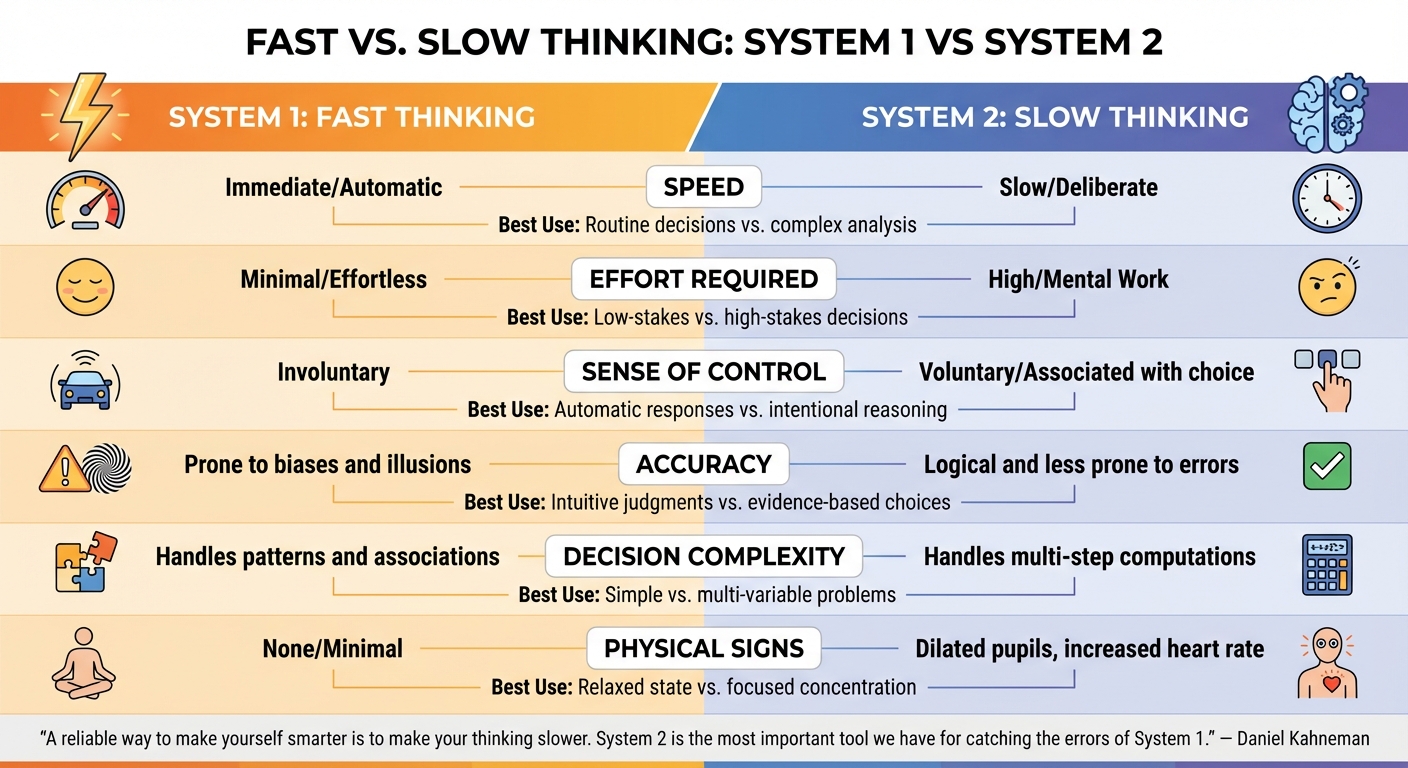
Fast vs Slow Thinking: System 1 and System 2 Comparison Chart
When you compare fast and slow thinking, the differences become immediately clear. These two mental systems - System 1 and System 2 - aren't at odds with each other. Instead, they work together, each stepping in based on what the situation calls for.
One of the most noticeable differences is energy use. System 1 runs on autopilot and doesn't drain your mental resources, while System 2 demands effort and can leave you feeling mentally drained. For instance, you can easily drive on a familiar route while chatting with a friend (System 1), but trying to solve "17 × 24" while navigating heavy traffic is nearly impossible. Both tasks would compete for the limited capacity of System 2’s focus and energy. This contrast highlights how each system plays a unique role in decision-making.
Control is another key distinction, especially in critical situations. System 1 reacts automatically, often without you even realizing it. On the other hand, System 2 steps in when you need deliberate control, helping you override impulsive reactions. For example, you might instinctively feel anger in response to a rude comment (System 1), but System 2 allows you to pause, think, and respond calmly instead of lashing out. This ability to manage impulses is one of System 2’s defining traits.
When it comes to accuracy, System 1 is quick and good at spotting patterns, but it often falls victim to biases and mental shortcuts. System 2, in contrast, works through problems methodically, catching errors that System 1 might overlook. This trade-off between speed and precision is why System 1 is perfect for snap judgments, while System 2 is better suited for tackling complex, high-stakes decisions.
Comparison Table
Here’s a quick breakdown of how these two systems differ:
| Aspect | Fast Thinking (System 1) | Slow Thinking (System 2) | Best Use Case |
|---|---|---|---|
| Speed | Immediate/Automatic | Slow/Deliberate | Routine decisions vs. complex analysis |
| Effort Required | Minimal/Effortless | High/Mental Work | Low-stakes vs. high-stakes decisions |
| Sense of Control | Involuntary | Voluntary/Associated with choice | Automatic responses vs. intentional reasoning |
| Accuracy | Prone to biases and illusions | Logical and less prone to errors | Intuitive judgments vs. evidence-based choices |
| Decision Complexity | Handles patterns and associations | Handles multi-step computations | Simple vs. multi-variable problems |
| Physical Signs | None/Minimal | Dilated pupils, increased heart rate | Relaxed state vs. focused concentration |
This table serves as a handy guide to understanding when to lean on intuition and when to engage in deeper analysis. Each system has its strengths, and knowing when to rely on which can make all the difference in decision-making.
When to Use Fast Thinking
Best Situations for Fast Thinking
Fast thinking shines in tasks that are second nature to us. Think about driving along a familiar route, tying your shoes, or doing the dishes - these are activities where System 1 takes over, saving your brain from unnecessary effort.
It’s also perfect for decisions where the stakes are low. For example, deciding what to eat for lunch or picking between two equally decent routes home doesn’t require much mental energy. System 1 handles these choices efficiently, letting you reserve your focus for more demanding matters.
In emergencies, fast thinking becomes crucial. Imagine needing to leap over a puddle, react to a sudden noise, or avoid a speeding taxi. In moments like these, there’s no time for deep analysis - your immediate reaction can be the difference between safety and harm.
Then there’s the power of expert intuition. A 2001 study in Nursing Research highlighted how experienced ER nurses often rely on gut feelings to detect patient deterioration, outperforming both novice nurses and even some objective measurements. Years of practice allow professionals like nurses, firefighters, or chess players to recognize patterns instinctively, enabling rapid and effective decision-making.
But this speed isn’t without its downsides - shortcuts sometimes lead to costly errors.
Risks of Relying Too Much on Fast Thinking
While System 1 is efficient, depending on it too much can backfire. One major issue is overconfidence. The mental shortcuts that System 1 uses can create systematic biases, leading to flawed judgments. For example, in the U.S., elderly individuals lose about $3 billion each year to financial scams. Why? They often default to automatic trust rather than pausing for critical analysis.
Anchoring bias is another trap. System 1 tends to latch onto the first piece of information it encounters, even if it’s irrelevant. That initial “anchor” can skew all subsequent decisions and judgments.
Fast thinking can also lead to overly optimistic planning. Take American homeowners as an example: they estimated kitchen remodels would cost $18,658 on average, but the actual expenses ballooned to $38,769. This shows how System 1 often overlooks obstacles and underestimates challenges, leading to unrealistic expectations.
When to Use Slow Thinking
Best Situations for Slow Thinking
Slow thinking becomes crucial in scenarios where the stakes are high - like making career changes, significant investments, or decisions that can't be undone. In these cases, precision is far more important than speed.
It's also necessary when dealing with complex problems. Our working memory can only hold 4–7 pieces of information at a time. So, when you're juggling multiple variables - like market trends, legal requirements, or internal resources - it's important to step back, organize your thoughts, and avoid relying solely on instinct.
When facing something entirely new, your intuition has no prior patterns to rely on. In such cases, slow and analytical thinking becomes your most dependable approach.
Another area where intuition falters is in statistical and probabilistic reasoning. Whether you're calculating investment risks or evaluating health outcomes, decisions that require understanding probabilities demand the deliberate processing power of System 2.
Lastly, professional and legal decisions often require logical, documented reasoning. Fast, intuitive judgments won't cut it here. As Daniel Kahneman wisely points out:
"System 2 is the most important tool we have for catching the errors of System 1".
When your decision needs to be justified or defended, relying on a "gut feeling" isn't enough. Recognizing these situations helps you know when to slow down and think critically.
How to Activate Slow Thinking
To engage System 2, consider implementing a 24-hour cooling-off period for major decisions. This pause allows emotions to settle and gives your mind time to process the information more thoroughly.
Another effective strategy is conducting a pre-mortem. Imagine a scenario where your decision fails a year down the line and identify what could go wrong. Studies show this approach can improve risk identification by around 30% compared to traditional planning methods.
Decision journaling is another helpful tool. By documenting your initial reasoning and assumptions, you'll not only learn from the process but also avoid judging decisions solely by their outcomes. A famous example of this is when Intel’s Andy Grove and Gordon Moore faced a tough strategic choice in the 1980s. Grove asked:
"If we got kicked out and the board brought in a new CEO, what do you think he would do?"
Moore’s response - "He would get us out of memories" - led Intel to pivot from memory chips to microprocessors, a decision that reshaped the company’s future.
Using checklists and structured frameworks can also be a game-changer. These tools help you offload information from your limited working memory and ensure no critical steps are missed. Research analyzing 1,048 business decisions over five years found that high-quality decision-making processes were 6.9 times more likely to lead to strong financial results than lower-quality processes.
Lastly, challenge your own assumptions by actively considering counterarguments. Ask yourself what conditions would need to exist for your intuitive choice to be wrong. As Charlie Munger explains:
"The first-level thinker says: 'It's a good company; let's buy the stock.' The second-level thinker says: 'It's a good company, but everyone thinks it's a great company, and it's not that good. The stock is overpriced; let's sell'".
Conclusion: Using Both Thinking Modes
When it comes to decision-making, the key is knowing how to balance fast and slow thinking. Fast thinking, or System 1, is great for routine tasks and quick judgments, while slow thinking, or System 2, shines when tackling complex problems. The trick is letting System 2 step in and double-check System 1's instincts when there's a chance for error.
Each system has its strengths. Fast thinking excels at spotting patterns, while slow thinking helps break down ideas into logical steps. This combination creates a solid foundation for knowing when to trust your gut.
For example, intuition works well in familiar situations with clear feedback - like a chess grandmaster instantly spotting the best move with about 70% accuracy. But when you're facing high stakes, complex problems, or unfamiliar territory, that's when you need to pause and engage slow thinking. Over time, tasks that require effortful thought can become second nature with practice, freeing up your mental energy for new challenges.
The real skill lies in understanding which mode to use in any given scenario. Before relying on intuition, make sure the situation is one where experience and feedback make it reliable. Confidence alone isn’t a guarantee of accuracy, especially in unpredictable environments where instinct often falls short.
FAQs
How can I tell which system is driving my decision?
When trying to figure out what’s driving your decisions, think about the process behind them. If your choice feels quick, instinctive, or based on habits, it’s likely the work of System 1 - the part of your mind that operates automatically and with little effort. On the other hand, if you find yourself analyzing details, comparing options, and reasoning through the situation, you’re tapping into System 2 - the slower, more deliberate side of decision-making. Understanding this distinction can give you better insight into how you make choices.
How do I reduce bias in fast thinking?
To make fast thinking less prone to bias, try strategies that promote deeper reflection and critical thinking. One approach is to question your first instinct by asking yourself, "What evidence could show I'm wrong?" This kind of self-challenge can help you see alternative perspectives.
Another helpful tactic is reframing problems. For instance, instead of thinking in terms of probabilities, consider them as frequencies. This shift often leads to more precise judgments. Lastly, becoming familiar with common cognitive biases and recognizing when automatic thinking kicks in can reduce errors during snap decisions.
How can I use slow thinking without getting decision fatigue?
To keep decision fatigue at bay while engaging in slow thinking, it's all about conserving your mental energy. One way to do this is by simplifying your day-to-day choices - set up routines or default options to minimize the number of decisions you need to make. Then, save your energy for the decisions that truly matter. Tackle these bigger choices when your mind is sharp, like early in the day when you're most refreshed.
It's also important to strike a balance. Use slow thinking for decisions that require deeper thought, but don't waste time overanalyzing the small stuff. This way, you can stay deliberate and thoughtful without draining yourself unnecessarily.
See also: Mental Energy Drain: Insights from Cognitive Science — the energy behind those decisions.
Make better decisions with a clearer mind. Try Fifteen →
See also: The Fifteen Manifesto — one tool for a focused mind.