Why Monotasking Improves Original Thinking
When you focus on one task at a time, you work better, think more clearly, and avoid mental fatigue caused by constant distractions. Multitasking, which is just rapid task-switching, lowers productivity by up to 40%, increases error rates, and blocks deeper thought processes. Monotasking, on the other hand, aligns with how your brain naturally works, allowing uninterrupted focus that leads to better results and sharper thinking.
Key Takeaways:
- Multitasking is inefficient: It drains mental energy, doubles errors, and disrupts focus.
- Monotasking boosts performance: It eliminates "attention residue" and creates the space for deeper thinking.
- Simple steps to monotask: Structure your time, minimize distractions, and create a workspace designed for focus.
By dedicating 20 minutes or more to a single task, you can achieve better outcomes and unlock higher levels of mental clarity.
The Problem: Multitasking Blocks Creative Thinking
Cognitive Overload and Its Effects
The human brain isn’t designed to juggle multiple cognitive tasks at once. What we often call "multitasking" is actually rapid task-switching. Each switch forces the brain to disengage from one task, reorient itself, and then re-engage with another. This process drains your prefrontal cortex - the part of your brain responsible for planning and decision-making - by burning through oxygenated glucose, leaving you mentally drained.
The cost of task-switching is steep. Studies show it can slash productivity by up to 40%, and just one interruption can take over 23 minutes to regain deep focus. Even minor distractions are costly: a three-second interruption can double error rates, while a five-second distraction quadruples them. These constant disruptions leave behind "attention residue", where fragments of the previous task linger in your mind, further impairing focus.
The impact of these distractions can be severe, especially in high-pressure environments. For example, a January 2025 study involving 257 nurses and 3,308 pediatric intensive care patients found that medication errors spiked significantly when nurses received a text or phone call within 10 minutes of administering medication. These interruptions not only hijack attention but also erode working memory, making it harder to perform critical tasks. Over time, this cognitive overload drains energy and prevents the sustained focus necessary for innovative thinking.
How Multitasking Limits Creativity
The mental toll of multitasking doesn’t stop at productivity - it also stifles creativity. Creative thinking thrives on prolonged focus, but multitasking disrupts this process by creating a "bottleneck" in the brain. Tasks are forced to queue up, making it nearly impossible to achieve the deep immersion needed for original ideas.
The effects are measurable. Multitasking during complex tasks can lower IQ scores by an average of 15 points - similar to the cognitive decline caused by pulling an all-nighter. Stanford Professor Clifford Nass highlighted how chronic multitaskers struggle with filtering out irrelevant information, organizing their thoughts, and smoothly transitioning between tasks:
Multitaskers are terrible at ignoring irrelevant information; they're terrible at keeping information in their head nicely and neatly organized; and they're terrible at switching from one task to another.
To reach a "flow" state, where creativity and productivity peak, the brain typically needs about 20 minutes of uninterrupted focus. Frequent interruptions prevent this state from being achieved. Worse still, chronic multitasking has been linked to physical changes in the brain, such as reduced gray matter density in the anterior cingulate cortex - the region responsible for cognitive control. In other words, multitasking doesn’t just disrupt your work today; it may also alter how your brain functions in the long run.
The Solution: Monotasking Enables Deep Focus
How Monotasking Reduces Mental Overload
Monotasking works in harmony with how your brain naturally processes information - sequentially, not simultaneously. Your prefrontal cortex, the part of the brain responsible for managing tasks, operates in a step-by-step manner. When you focus on just one task, you align with this natural design, allowing your brain to fully engage without the constant energy drain caused by switching between tasks.
By cutting out task-switching, monotasking eliminates "attention residue", the lingering thoughts about unfinished tasks that sap mental energy. It also addresses Zeigarnik loops, which are those nagging thoughts about incomplete activities, freeing up more cognitive resources.
The benefits of monotasking aren't just theoretical. Organizations that adopt structured focus time policies report improvements of 15% to 25% in project completion rates and the quality of their output. On a global scale, multitasking-related productivity losses cost the economy an estimated $450 billion every year. Monotasking doesn't just improve how you feel - it delivers measurable results. By clearing mental clutter, it creates the space needed for sustained focus and meaningful problem-solving.
Deep Focus and Creative Thinking
When mental distractions are minimized, monotasking creates the conditions necessary for deep, uninterrupted focus - an essential ingredient for creativity. Research shows that it takes about 20 minutes of continuous focus to move from surface-level thinking into deeper, more innovative thought processes. Multitasking disrupts this transition, often cutting off the opportunity for deeper insights before they can even begin.
Monotasking, on the other hand, removes interruptions and supports the sustained engagement required to reach a state of flow. As researchers Fullagar and Kelloway explain, this state is delicate: "As soon as attention shifts to try to maintain control, flow dissipates". The first 15 to 20 minutes of focused work are often spent clearing residual thoughts from previous tasks. Only after this initial period can the mind truly delve into creative and structural thinking, making uninterrupted time blocks critical for innovation.
The difference is clear. Multitasking creates a mental traffic jam, forcing tasks to line up and preventing deep focus. In contrast, monotasking clears the way for your brain to make the complex connections that lead to groundbreaking ideas. Studies show that single-task focus improves long-term memory encoding by 23% and enhances cognitive performance by as much as 50% compared to multitasking. By dedicating your attention to one task at a time, you not only perform better but also unlock a higher level of thinking.
How to Stop Multitasking and Boost Your Focus and Productivity in 2024
sbb-itb-d395ae5
Monotasking vs. Multitasking: A Direct Comparison
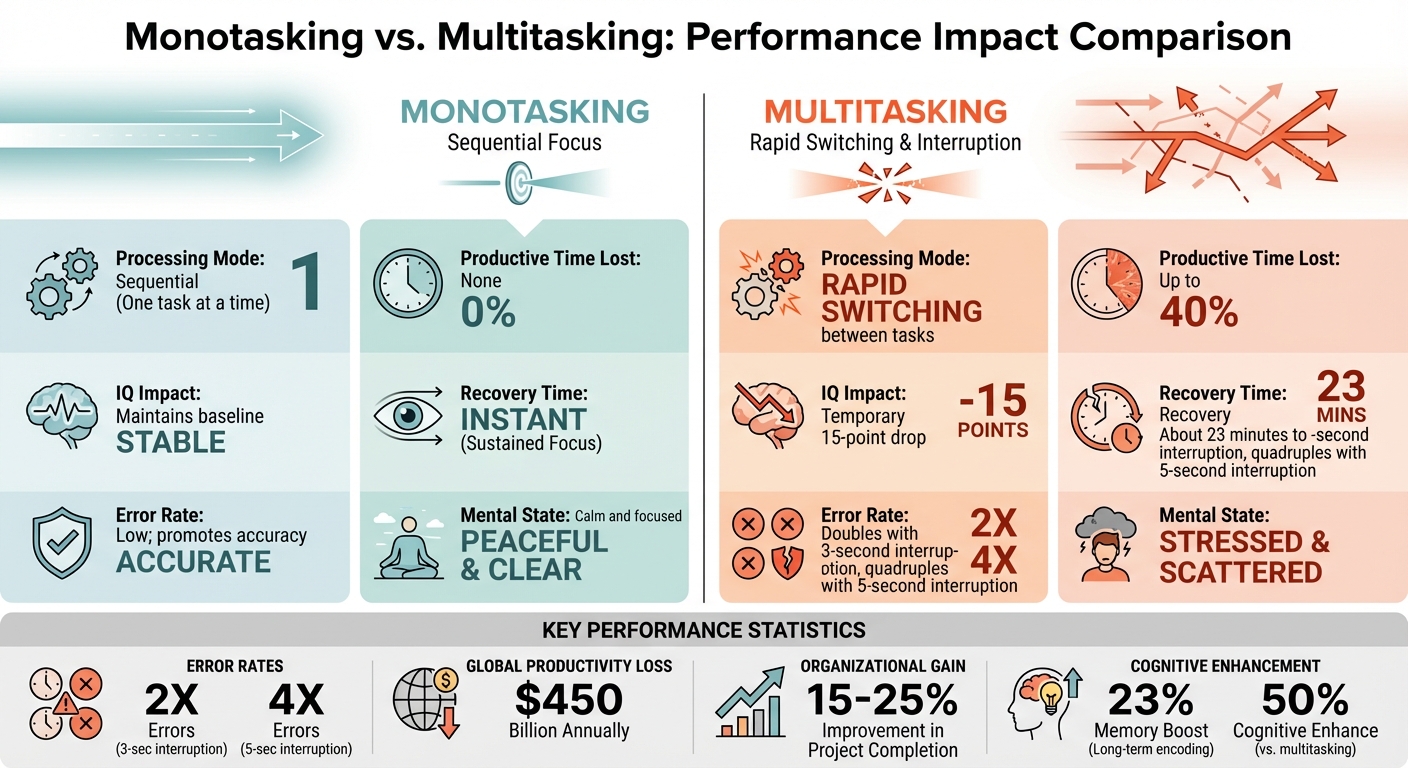
Monotasking vs Multitasking: Performance Impact Comparison
The contrast between monotasking and multitasking is striking. When you think you’re multitasking, what’s really happening is rapid task-switching - your brain constantly shifts focus between tasks. This process creates a bottleneck, forcing each task to wait its turn. The result? A heavy toll on your mental resources as your brain adjusts to new goals and rules.
Multitasking doesn’t just dilute productivity - it can actively harm it. Studies show that it wastes a significant chunk of productive time and can even lower performance to levels comparable to being sleep-deprived. MIT neuroscientist Earl Miller highlights this reality:
People can't multitask very well, and when people say they can, they're deluding themselves.
Even a brief distraction can derail focus. Research shows it takes over 23 minutes to regain deep concentration, and error rates skyrocket during this recovery period. Stanford researcher Clifford Nass found that habitual multitaskers struggle to filter out irrelevant information and organize their thoughts effectively. As he puts it:
They're suckers for irrelevancy. Everything distracts them.
These findings underscore the mental strain caused by multitasking and highlight the clear advantages of monotasking. Let’s break it down further:
| Feature | Monotasking | Multitasking (Task-Switching) |
|---|---|---|
| Processing Mode | Sequential (one task at a time) | Rapid switching between tasks |
| Productive Time Lost | None | Up to 40% |
| IQ Impact | Maintains baseline | Temporary 15-point drop |
| Recovery Time | None (sustained focus) | About 23 minutes to regain deep focus |
| Error Rate | Low; promotes accuracy | Doubles with a 3-second interruption, quadruples with a 5-second one |
| Mental State | Calm and focused | Increased stress and lingering attention residue |
Monotasking avoids the pitfalls of multitasking entirely. By focusing on one task at a time, you maintain steady momentum and preserve your mental energy for deeper thinking and problem-solving. This approach keeps your brain in a single context, allowing you to work more effectively and with less stress. These stark differences make a strong case for adopting monotasking in everyday life.
How to Practice Monotasking
Set Up Your Space for Focus
Creating a workspace that encourages focus can make a big difference in your ability to monotask. A designated area for deep work helps train your brain to associate that space with concentration. If space is tight, try using a specific "focus trigger" like turning on a desk lamp only during work sessions.
Position your workspace away from busy areas or doorways to minimize interruptions. Keep the noise level low - ideally under 55 decibels. Noise-canceling headphones or instrumental brown noise can help if your environment is naturally loud.
Time-Blocking and Task Prioritization
Optimizing your workspace is just one piece of the puzzle; structuring your time is equally important.
Plan your most mentally taxing tasks during the hours when you're naturally most alert - often 2–4 hours after waking up. These tasks should take priority over meetings or administrative work. As Cal Newport wisely notes, "An unscheduled day defaults to whatever is loudest, not whatever matters most".
Be specific when defining tasks. For instance, instead of writing "work on project", say "draft five overview slides." This clarity reduces decision fatigue and keeps you on track. Allow for 30-minute buffers between major tasks to handle unexpected delays without throwing off your entire day. For reactive tasks like checking emails, batch them into 2–3 specific time slots to avoid constant interruptions.
Simplify Your Information Sources
Once your schedule is set, cutting down on digital distractions is key to staying focused.
Jumping between multiple information sources leaves behind "attention residue", which saps your mental energy. Research shows that heavy multitaskers struggle more to filter out irrelevant information, making them less effective overall.
To stay on track, close unnecessary browser tabs and apps, and keep your phone out of reach - preferably in another room. For consuming content, tools like Fifteen offer a clean, ad-free feed from up to 15 sources, helping you avoid algorithm-driven distractions. Pairing this digital decluttering with your scheduling and workspace strategies can help you maintain focus and support deeper, more intentional work.
Conclusion
Monotasking has the power to transform how we approach creative work by cutting through distractions, easing mental fatigue, and enabling the brain's prefrontal cortex to dive into complex challenges deeply and effectively. This approach doesn’t just improve the quality of your work - it also strengthens memory and makes it easier to reach those flow states where fresh, groundbreaking ideas take shape.
Studies reveal that monotasking boosts cognitive performance and lowers stress, while also preventing up to 40% of productivity loss caused by multitasking. By maintaining focus for just 20 minutes or more, you create the ideal mental conditions for clarity and creative problem-solving.
Start small: choose one task, dedicate 20 distraction-free minutes to it, and observe how your focus sharpens. Use the strategies we've covered - design a workspace free of interruptions, block out time for demanding tasks, and streamline the information you consume. These steps help minimize mental clutter, allowing your mind to zero in on what truly matters. Multitasking may scatter your thoughts, but monotasking clears the way for deeper connections and meaningful innovation.
FAQs
How do I start monotasking if my job is interruption-heavy?
In jobs where interruptions are the norm, monotasking can feel nearly impossible. But with some smart strategies, it's entirely doable.
Start by scheduling dedicated blocks of time for focused work. Let your coworkers know about these periods so they can respect your need for uninterrupted time. Clear communication is key here.
Next, cut down on distractions. Turn off notifications, close any tabs that aren’t relevant to your task, and set boundaries - whether that means putting up a “Do Not Disturb” sign or politely asking colleagues to hold non-urgent matters until later.
Finally, don’t forget to take regular breaks. Brief pauses can recharge your brain, making it easier to dive back into your work with renewed focus.
Over time, practicing these habits can help you build better concentration, even in the busiest of environments.
What should I do when I get the urge to check email or my phone?
When you feel the pull to check your email or scroll through your phone, try to resist the distraction and bring your focus back to monotasking. By concentrating on one task at a time, you can reduce mental strain and improve your ability to focus. This approach not only clears up mental clutter but also encourages deeper thought and sparks creativity, ultimately leading to more effective and satisfying results.
How can I maintain a clean information diet without missing key updates?
To keep your information intake focused and manageable, try monotasking - dedicating your attention to one task or source at a time. This approach helps minimize mental clutter and improves your ability to concentrate. You can streamline this further by using a curated feed or tools like Fifteen to track a select group of reliable sources. Steering clear of algorithm-driven distractions allows you to stay updated while absorbing and remembering the most important information.
See also: Why Your Feed Should Have a Limit — monotasking starts with a bounded feed.
Go deep on one thing at a time. Try Fifteen →