7 Signs You Need a Social Media Detox Right Now
Ever feel like social media is taking over your life? From endless scrolling to constant comparisons, these habits might be affecting your mental clarity, emotional well-being, and relationships. Here's a quick snapshot of the signs it's time to step back:
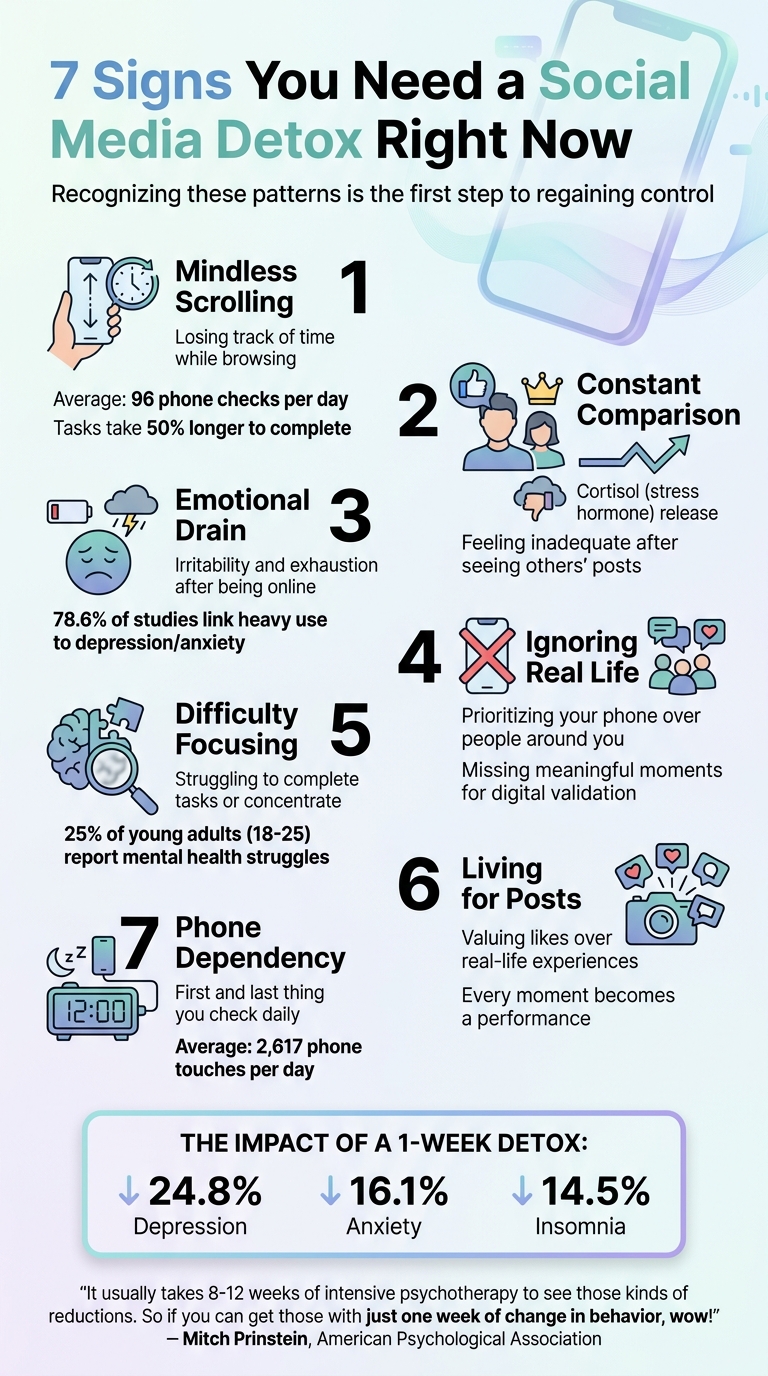
- Mindless Scrolling: Losing track of time while browsing.
- Constant Comparison: Feeling inadequate after seeing others' posts.
- Emotional Drain: Irritability and exhaustion after being online.
- Ignoring Real Life: Prioritizing your phone over people around you.
- Difficulty Focusing: Struggling to complete tasks or concentrate.
- Living for Posts: Valuing likes over real-life experiences.
- Phone Dependency: Checking social media first thing in the morning and last at night.
Recognizing these patterns is the first step to regaining control. Studies show even a one-week detox can reduce depression by 24.8% and anxiety by 16.1%. Ready to reclaim your time and mental space? Let’s dive into the details.
7 Signs You Need a Social Media Detox and Their Mental Health Impact
Wellness Webisode: A Digital Detox Is Good for Your Health
sbb-itb-d395ae5
1. You Scroll Without Thinking
Ever unlock your phone just to check the time, only to find yourself 40 minutes deep into your social media feed? Psychologist Dr. Adam Borland from Cleveland Clinic sums it up perfectly:
"You're not in the moment, and you've gone on autopilot, like your thumbs have a mind of their own".
This "autopilot" mode can have serious effects. On average, people check their phones 96 times a day, and every interruption makes tasks take 50% longer to finish. Jumping from one post to another fragments your attention, leaving your working memory strained and making it harder to focus - even when you're offline.
Behavioral Patterns That Signal Overuse
Certain habits can hint at excessive phone use. These include instinctively grabbing your phone, scrolling during meals or meetings, or starting and ending your day glued to social media. If you’ve ever caught yourself scrolling for an hour without realizing it, it could point to what experts call a "dopamine deficit" state. These patterns don’t just eat up time - they also cloud your mental clarity throughout the day.
How It Affects Mental Clarity
Mindless scrolling doesn’t just waste time - it leaves your brain in a fog that lingers long after you put down your phone. Will Moore, founder of Moore Momentum, explains:
"The practice trains your brain to crave instant gratification, making deep work and sustained concentration increasingly difficult".
This overstimulation overloads your brain with dopamine, which over time reduces its natural production. The result? A constant mental haze that makes critical thinking and decision-making feel like uphill battles.
2. You Compare Yourself to Others Constantly
Scrolling through social media can feel like flipping through a highlight reel of perfect lives. It’s easy to fall into the trap of thinking your own life doesn’t measure up. Recognizing these emotional triggers is crucial to knowing when it’s time for a break. Dr. Adam Borland of Cleveland Clinic explains:
"When you negatively compare yourself to what you see online, you can start feeling like your own life is lacking".
This comparison isn't just emotional - it’s physical too. Your body reacts by releasing cortisol, a stress hormone that can linger in your system long after you’ve closed the app.
Effect on Emotional Well-Being
A study conducted in December 2025 by Dr. John Torous and his team at Harvard Medical School and Beth Israel Deaconess Medical Center revealed some eye-opening findings. They observed young adults who took a one-week break from social media and found that depression levels dropped by 24.8%, anxiety decreased by 16.1%, and insomnia improved by 14.5%. Another review showed that 78.6% of studies linked heavy or passive social media use to heightened feelings of depression, anxiety, and loneliness. It’s not surprising, then, that 35% of American adults in 2024 took deliberate breaks from social media because of its negative impact on their mental health.
Behavioral Patterns Indicating Overuse
These emotional and physiological effects often show up in the way we interact with social media. For example, do you find yourself obsessively checking accounts that make you feel inadequate - what some call "hate follows"? Or maybe you’re constantly doubting your career choices, vacation plans, or even your lifestyle after a scroll session. If you can’t enjoy a meal without snapping a photo first, it might be a sign that comparison has taken over.
Beyond the emotional toll, this constant comparison can drain your mental energy. Your brain gets bogged down by the endless micro-decisions - what to click, like, or react to - leading to cognitive fatigue. It’s a cycle that can leave you feeling emotionally and mentally exhausted.
3. You Feel Drained and Irritable
If you find yourself snapping at others or feeling mentally exhausted after scrolling through social media, it could be a sign that your brain's dopamine balance is out of sync. Anna Lembke, an addiction medicine expert from Stanford University, explains:
"Endless scrolling eventually disrupts this balance, prompting the brain to compensate by producing less dopamine... this can lead us into a state of 'dopamine deficit,' where we need more time online to get back to feeling 'normal'".
This imbalance doesn't just drain your energy - it can also cloud your mental clarity.
Impact on Mental Clarity
Our brains aren't designed to handle the constant flood of information that social media delivers daily. This overload can leave you mentally fatigued. In fact, Oxford University Press chose "brain rot" as the 2024 word of the year to highlight the cognitive decline linked to excessive digital consumption. Jumping from one emotional extreme to another - laughing at a meme one moment and feeling upset by a news story the next - further depletes your mental energy. Over time, this makes it harder to concentrate on what truly matters. If you're noticing these struggles, it might be time to step back and reassess your digital habits.
Effect on Emotional Well-Being
Do you feel restless, anxious, or impatient when you're away from your phone? These feelings are withdrawal symptoms, similar to those experienced in other forms of addiction. On top of that, scrolling through negative news or online arguments can create a cycle of anger, envy, and irritation, chipping away at your emotional resilience. While a quick 30-minute social media session might temporarily ease loneliness, longer sessions often have the opposite effect, leaving you feeling more isolated. These emotional fluctuations can eventually spill over into your everyday behavior.
Behavioral Patterns Indicating Overuse
Take a moment to reflect on how often you reach for your phone. The average American adult touches their smartphone a staggering 2,617 times per day. If you find yourself checking your phone without a clear reason, it could be a sign of overuse. Additionally, spending too much time immersed in negative content may leave you feeling desensitized to others' struggles. When your phone starts dictating your habits instead of the other way around, it’s a clear signal that a digital detox might be in order.
4. You Ignore People Around You
Have you ever found yourself scrolling through Instagram while your partner is sharing their day? Or maybe you're out to dinner with friends, but your attention keeps drifting back to your phone? This kind of behavior, often called phubbing (phone snubbing), doesn't just hurt your focus - it can seriously damage your real-life connections. Social media might be quietly taking over your ability to be truly present.
Patterns That Show Overuse
Do you check your phone without even thinking about it? This habit can sneak into moments that should be meaningful, like family dinners, work meetings, or even movie nights. Instead of enjoying the moment, some people get so caught up in capturing it for social media that they miss the experience entirely. Over time, this behavior can create a gap between you and your loved ones, leaving you feeling disconnected and mentally scattered.
How It Affects Emotional Connections
This constant digital distraction can weaken your relationships. Dr. Adam Borland, PsyD, a clinical psychologist, explains:
"Instead of having a cup of coffee with a friend, you're communicating by DM. When you lack direct human connection, you can start to feel isolated".
When you're physically present but mentally elsewhere, it sends a message to those around you. Friends and family might notice your constant phone use, which can lead to tension or misunderstandings. Beyond that, spending so much time online can dull your sense of empathy. Dr. Borland points out:
"People get brazen online and say things they'd never say face-to-face. We become numb. We lose that sense of empathy and compassion".
The Toll on Your Mental Clarity
Constantly switching between your phone and the real world can leave your mind feeling overloaded. This kind of mental fatigue makes it harder to focus on conversations or even remember details from them. You might find yourself asking people to repeat things because you weren’t fully tuned in. Over time, this pattern of distraction can create a mental haze that affects how you connect with the world around you. If your phone is deciding where your attention goes instead of the people in front of you, it’s a clear signal to rethink your priorities. Noticing these habits is the first step toward reclaiming your focus and strengthening your relationships.
5. You Can't Focus or Get Things Done
If your to-do list keeps growing while your screen time does too, it might be time to take a closer look at how social media is affecting your focus. Feeling like you're in a mental fog, struggling to concentrate on work, or constantly battling the urge to check your phone? These are signs that social media might be draining your productivity. It's not just about losing time; it's about how endless digital stimulation changes your brain's ability to focus. Over time, these habits can create a cycle where your attention gets pulled in every direction.
Behavioral Patterns That Show Overuse
Do you find yourself reaching for your phone without thinking? This automatic behavior can sneak into your workday, making it harder to stay on task. You might open an app for a quick check, only to lose an hour scrolling without realizing it. This phenomenon, often called "time blindness", happens when you lose track of time entirely . These interruptions derail your workflow, leaving tasks incomplete and your sense of time distorted.
How Productivity Takes a Hit
Notifications are like tiny wrecking balls for your focus. Each one pulls you away from deep work, forcing your brain to switch gears repeatedly. Over time, this trains your brain to crave short bursts of information instead of sustained focus. Anna Lembke, an addiction medicine expert at Stanford University, explains that constant scrolling disrupts your brain's reward system. This can lead to a "dopamine deficit" - your brain produces less dopamine or slows its transmission, making it harder to concentrate on tasks that require effort. The result? You might spend more time online just to feel okay, while everything else feels harder and more draining.
The Mental Fog of Overload
Ever feel like your brain is overloaded, even with simple decisions? This "mental fog" can be a direct result of too much digital input. Social media floods your brain with more information than it can handle, leading to cognitive overload. Research shows that 25% of young adults aged 18–25 report mental health struggles, with heavy social media use often linked to concentration and memory issues. Your attention span shrinks as your brain gets used to processing quick snippets of information instead of focusing deeply . If you're forgetting details, struggling to complete tasks, or feeling mentally drained, your social media habits could be playing a bigger role than you think. Recognizing these patterns is a crucial first step in regaining control and clarity.
6. You Care More About Posting Than Living
Let’s talk about those moments when capturing the perfect post becomes more important than actually living the experience. Think about it: snapping a picture of your dinner before you even taste it or recording a concert instead of enjoying the music. These habits go beyond being quirky - they’re signs that social media may be pulling you away from being present. If this sounds familiar, it might be time to step back and refocus on the here and now.
Behavioral Patterns Indicating Overuse
Certain behaviors make it clear when social media is taking over. Maybe you instinctively reach for your phone to document every moment, or perhaps you feel like an event doesn't truly "count" unless it's shared online. Psychologist Adam Borland from Cleveland Clinic captures this perfectly:
"The pressure to perform can overtake any real enjoyment of using social media".
When you’re obsessing over the perfect angle for a sunset shot or glued to your screen waiting for likes, you’re prioritizing digital validation over meaningful experiences.
Impact on Mental Clarity
This constant need to document creates an overload of information, making it harder to focus. Studies even suggest that excessive social media use can impair attention in ways similar to a decade of cognitive aging. You might find yourself scrolling without intention, stuck in "autopilot mode." As Borland explains:
"You're not in the moment, and you've gone on autopilot, like your thumbs have a mind of their own".
This mental fog doesn’t just leave you feeling drained - it also makes it harder to engage with the real world. Instead of being fully present, your attention gets hijacked by the endless loop of posting and scrolling.
Effect on Emotional Well-being
Relying on social media for validation can leave you feeling hollow, turning every moment into a performance for likes. Addiction expert Anna Lembke breaks it down:
"Endless scrolling eventually disrupts this balance... leading us into a state of 'dopamine deficit,' where we need more time online to get back to feeling 'normal'".
The result? A disconnect between the image you project and how you actually feel. You might look carefree on Instagram but feel anxious or empty inside. In fact, a 2024 survey revealed that 35% of American adults have taken breaks from social media because of its negative impact on their mental health.
It’s a sobering reminder of how social media can reshape not just how we live but how we feel.
7. Social Media Is the First and Last Thing You Check
If you find yourself starting and ending your day glued to your phone, it’s a sign that social media has become a deeply ingrained habit. This routine can have a significant impact on your mental clarity and emotional health.
How Overuse Manifests
Studies reveal that people touch their smartphones an average of 2,617 times daily and spend about 3.5 hours on social media before bed. Psychologist Adam Borland from Cleveland Clinic emphasizes:
"If the first thing you do when you open your eyes is reach for your phone, that's something to pay attention to."
Morning and nighttime scrolling often feel automatic - you might not even realize how much time passes. A quick check can easily turn into an hour or more, leaving you mentally drained before your day begins or restless as you try to wind down.
Mental Clarity Takes a Hit
Scrolling through social media first thing in the morning or right before bed can wreak havoc on your focus. These habits create a cycle of dopamine spikes and crashes, disrupting your brain's natural balance. This overconsumption has become so prevalent that Oxford University Press dubbed "brain rot" the 2024 word of the year to describe the mental fog that results.
Additionally, late-night scrolling is notorious for disturbing sleep. Poor sleep quality leads to reduced focus and productivity the following day. Interestingly, a two-week digital detox has been shown to reverse up to a decade of age-related cognitive decline.
Emotional Well-Being Suffers Too
Kicking off your day with a flood of perfectly curated social media posts can trigger feelings of inadequacy and raise cortisol levels, setting a stressful tone for the hours ahead. At night, the same habit can disrupt your sleep, leading to irritability, anxiety, and even depression.
A 2025 study led by John Torous at Harvard Medical School and Elombe Calvert, published in JAMA Network Open, tracked 373 young adults aged 18 to 24. Participants who reduced their social media use from two hours to just 30 minutes per day for one week reported a 24% drop in depression symptoms and a 16% decrease in anxiety. Mitch Prinstein of the American Psychological Association commented:
"It usually takes eight to 12 weeks of intensive psychotherapy to see those kinds of reductions in mental health symptoms. So if you can get those with just one week of change in behavior, wow!"
These results highlight how even small adjustments, like avoiding social media in the morning and at night, can make a big difference in your emotional health and overall well-being.
How to Start Your Social Media Detox
If you're looking to clear your mind and regain emotional balance, taking action is key. Start by identifying when you're most likely to fall into the trap of mindless scrolling. Is it during lunch breaks, before bed, or right after waking up? Recognizing these moments helps you pinpoint triggers and develop strategies to avoid them. This self-awareness is the first step toward a successful detox.
Once you've identified your patterns, set firm boundaries for your detox. Decide how long you'll step back - whether it's a weekend, a week, or even a month - and outline specific rules for your social media use. For a complete break, you might delete the apps entirely. Alternatively, you could limit yourself to two 10-minute sessions per day. Writing down your plan can help you stay committed.
Let your friends and family know about your detox so they won't worry if you're slower to respond. This also reduces the pressure to be constantly available, giving you the freedom to focus on yourself.
Make adjustments to your environment to minimize temptation. Delete social media apps, log out of your accounts, and turn off notifications. Use built-in tools like screen time controls to enforce limits - for instance, setting a maximum of 15 minutes at lunch and another 15 minutes after dinner.
Not ready to quit entirely? Try reshaping your social media experience. Unfollow or mute accounts that spark anxiety or unhealthy comparisons. You can also use tools like Fifteen, which lets you follow a limited number of accounts - 5 on the Free plan or up to 15 on Pro ($7/month) - in a chronological, ad-free feed. This approach encourages intentional use, allowing you to check in with people you genuinely care about before moving on with your day.
Conclusion
If you find yourself mindlessly scrolling, constantly comparing yourself to others, feeling exhausted, neglecting the people around you, struggling to concentrate, prioritizing posts over real-life experiences, or checking your phone first thing in the morning and last thing at night - these are strong indicators that it’s time to step back. Each of these habits reveals the same core problem: social media is no longer serving you; it’s running the show.
The first step toward change is recognizing these patterns. Here’s the upside: making even small adjustments to your digital habits can lead to noticeable improvements in your well-being. A one-week social media detox has been shown to reduce anxiety by 16.1%, depression by 24.8%, and insomnia by 14.5%. As Mitch Prinstein, Chief of Strategy and Integration at the American Psychological Association, puts it:
"It usually takes eight to 12 weeks of intensive psychotherapy to see those kinds of reductions in mental health symptoms. So if you can get those with just one week of change in behavior, wow!"
You don’t have to delete your apps or disappear from the online world entirely. The goal is to use social media deliberately - to make it work for you instead of letting it control your time, emotions, and relationships. Even small steps, like limiting your usage to 30 minutes a day, can ease loneliness and help restore balance.
Start by observing your habits and paying attention to how you feel every time you reach for your phone. That self-awareness is the foundation for meaningful change. Remember, your real life is unfolding right now - not on a screen. Taking back control begins with a single, intentional choice.
FAQs
How long should a social media detox last?
A social media detox usually lasts at least one week to notice improvements in mental health. That said, the ideal length depends on individual preferences. It could be as short as a weekend or stretch to an entire month. Begin with a duration that feels realistic for you, and tweak it if necessary to restore balance and focus in your life.
What should I do instead of scrolling when I feel the urge?
When you feel the need to scroll, consider swapping it out with activities that encourage mindfulness and boost well-being. Try deep breathing exercises, a short meditation session, or even a quick stretch or walk. Recognizing what triggers this urge and practicing mindfulness can help redirect your attention, making it easier to break the habit. These simple shifts not only promote mental clarity but also help you regain control over your time and focus.
How can I detox without missing important messages?
To step back from social media without losing touch, start by setting clear boundaries. For instance, designate specific times - like mornings and evenings - for checking messages. This way, you stay updated without feeling tethered to your device all day.
Take advantage of tools like "Do Not Disturb" or app notification settings to minimize distractions. These features can help you avoid the constant pull of alerts and focus on what truly matters.
It’s also a good idea to let your close friends and family know about your detox plan. Share your schedule so they can reach out directly in case of urgent matters. This approach keeps you connected to essential communications while prioritizing your mental well-being.
Reclaim your attention. Try Fifteen →
See also: How Social Comparison Drives FOMO in Feeds — the psychological trap behind the scroll.