Algorithm Fatigue: How to Fix Information Overload
Feeling drained by endless scrolling? You're not alone. Algorithms flood us with content designed to keep us hooked, but the cost is high: lost time, mental exhaustion, and reduced productivity. The average person processes 34GB of data daily, and attention spans have dropped to 8.25 seconds. This overwhelm costs the U.S. economy $997 billion annually and leaves many stuck in decision paralysis.
Here’s the fix in three steps:
- Set boundaries: Limit daily content consumption to focused sessions and cut unnecessary notifications.
- Declutter your feeds: Unfollow low-value sources and curate a manageable list of 10-15 trusted ones.
- Build a personal archive: Save only essential content, organize it, and review weekly for easy access.
Regain control by consuming smarter, not more. Tools like Fifteen (an ad-free feed reader) can help you escape algorithm-driven chaos and focus on what truly matters. Ready to reclaim your attention? Let’s dive in.
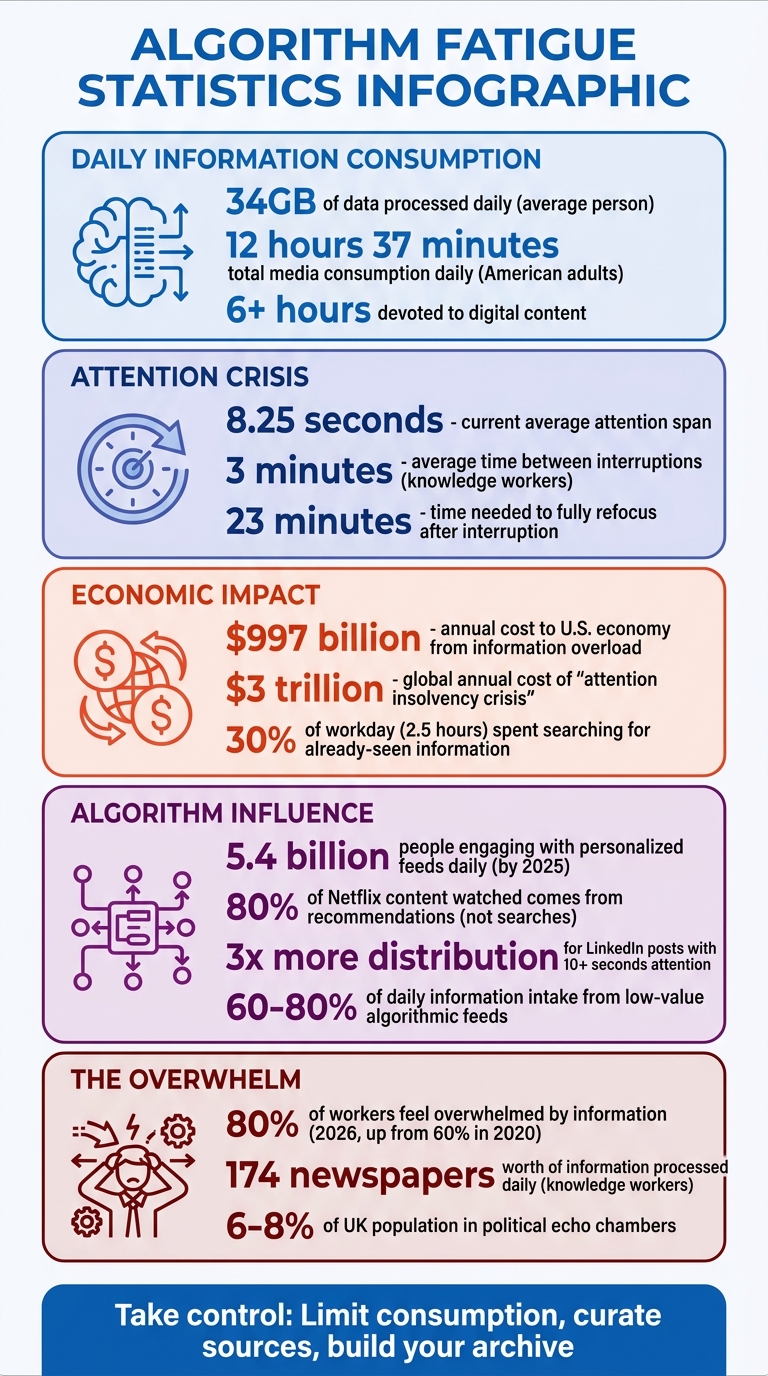
The True Cost of Algorithm Fatigue: Key Statistics on Information Overload
How Algorithms Create Information Overload
How Recommendation Engines Work
Today, platforms don’t just show you a simple chronological feed. Instead, every piece of content you see is ranked with a score based on how likely you are to interact with it. This score considers factors like likes, shares, how long you linger on a post, and even your relationship with the person who shared it. By 2025, over 5.4 billion people will be engaging with these personalized feeds daily.
Here’s the catch: the system isn’t concerned with quality - it’s focused on keeping you hooked. Take LinkedIn, for example. Posts that hold your attention for more than 10 seconds can get 3x more distribution. Similarly, comments with 10+ words generate 2.5x more reach than quick reactions like a thumbs-up. To maximize engagement, algorithms often prioritize content that stirs strong emotions - whether it’s outrage, fear, or indignation - because those emotions consistently drive higher interaction than neutral or calm content. As Allison McSorley of Safe Online Futures explains:
"The algorithm doesn't know or care that outrage is corrosive or that fear is exhausting. It only knows that these emotions produce the signals it has been trained to maximize."
Every pause, click, or share you make teaches the algorithm what grabs your attention. For instance, spending time on polarizing or anxiety-inducing content strengthens the algorithm’s signals, shaping your feed to make these types of posts feel urgent or even normal. Platforms like Netflix demonstrate the power of these systems - more than 80% of what people watch comes from personalized recommendations rather than active searches.
While these systems boost engagement, they also take a toll on your mental energy, as the next section explores.
The Mental Cost of Endless Scrolling
Features like infinite scroll and autoplay are designed to minimize "cognitive friction", the mental effort required to stop and reflect. But this convenience comes at a cost - it drains your cognitive reserve, the mental capacity you need for deep thinking and focus. Globally, this "attention insolvency crisis" is estimated to cost around $3 trillion annually in lost productivity and cognitive capacity.
For knowledge workers, the situation is even more pressing. They’re interrupted or switch tasks every 3 minutes on average. Worse, it takes about 23 minutes to fully refocus after each interruption. Algorithms, with their constant stream of notifications and prompts, keep you reacting rather than reflecting. AttentionDebt.org highlights the broader societal impact:
"Democracy assumed cognitive solvency. We're systematically producing cognitive bankruptcy."
This constant mental exhaustion doesn’t just affect productivity - it also traps you in repetitive content cycles, further narrowing your perspective.
Filter Bubbles and Echo Chambers
Algorithms don’t just personalize content; they create intellectual silos. By tailoring what you see based on your past behavior, location, and search history, they limit exposure to diverse viewpoints. In the UK, for instance, an estimated 6% to 8% of people find themselves in politically partisan online echo chambers. These aren’t just gaps in information - they’re environments where outside perspectives are actively discredited. This creates a feedback loop: your engagement shapes what you see, which influences your thoughts, and those thoughts guide future engagement.
False information thrives in these environments. It spreads faster than corrections because it’s more emotionally charged, giving it a higher ranking in algorithmic systems. Content creators, aware of these dynamics, now design their work to meet algorithmic preferences - like specific video lengths or multi-image posts - rather than focusing on creativity or quality. Megan Ellis, a Pop Culture and Lifestyle Writer, sums it up perfectly:
"The algorithm doesn't know what you need - only what you've clicked on before. And those are very different things."
This narrowing of perspectives doesn’t just contribute to algorithm fatigue - it also highlights the importance of deliberately seeking out diverse and meaningful content.
How Algorithms Exacerbate Decision Fatigue & What You Can Do About It? with Tim Lindley
How to Fix Algorithm Fatigue
Algorithm fatigue can be tackled by shifting from passive scrolling to intentional content selection. Studies show that 60% to 80% of our daily information intake comes from low-value algorithmic feeds and push notifications. The tips below can help you regain control over your time and mental energy, starting with setting boundaries on your content consumption.
Set Daily Time Limits for Content Consumption
Your attention span is finite, but the flow of information is endless. The average American adult spends a staggering 12 hours and 37 minutes consuming media daily, with over 6 hours devoted to digital content. This level of consumption isn't sustainable for long-term cognitive health. By setting clear time limits, you can focus on quality over quantity.
Start with a 20 to 40-minute window for daily information intake. Break this into one or two focused sessions, such as 30 minutes after lunch and 20 minutes in the evening. Many knowledge workers who adopt this approach report cutting their time spent searching for information by 60% to 70%.
Turn off push notifications except for essential contacts. Notifications disrupt focus, leaving behind "attention residue", where part of your mind stays stuck on the previous task. This constant interruption can degrade performance and contributes to the estimated $997 billion annual cost of information overload in the U.S. economy.
You can also try the one-in-one-out rule: every time you add a new information source, remove an old one. This keeps your content manageable and reduces unnecessary noise.
Review and Clean Up Your Content Sources
A significant part of information overload stems from sources that don’t add real value. By 2026, 80% of workers reported feeling overwhelmed by information, up from 60% in 2020. The solution? Don’t try to consume faster - instead, focus on consuming smarter.
Start by performing a feeds reboot. Review your subscriptions, follows, and notifications across platforms. Apply the 30-day unsubscribe rule: if you haven’t opened a newsletter or visited a feed in the past month, unsubscribe immediately. As David Pierce from The Verge aptly puts it:
"If you don't tend to your algorithms, you'll eventually hate what they show you."
Next, apply the 70% rule for curation: keep a source only if you consistently engage with at least 70% of its content. If you’re barely reading one out of every five articles, that source is likely adding more noise than value.
For sources you decide to keep, consider declaring information bankruptcy on your backlog. If you’re overwhelmed by hundreds of unread items, archive them all without guilt and start fresh. This can significantly reduce the mental load.
Make it a habit to conduct a quarterly source audit every 90 days. Aim to trim 30% to 40% of your sources while maintaining the ones that align with your goals or provide unique insights. Ask yourself: Does this source genuinely add value? If not, let it go.
Once your sources are streamlined, switch to tools that provide unfiltered, chronological feeds for a more focused experience.
Use Fifteen for Algorithm-Free Reading
After decluttering your content sources, you’ll need a tool to consume information without falling back into algorithm-driven chaos. Enter Fifteen, a read-only feed reader that allows you to follow up to 15 people via RSS. You can pull content from platforms like YouTube, Substack, Medium, or any blog with an RSS feed.
The standout feature? No algorithms. Fifteen gives you a simple, chronological feed of exactly what you’ve chosen to follow, in the order it was published. There are no ads, recommendations, or tracking - just the content you want.
The 15-follow limit encourages you to be selective about who gets your attention, preventing the gradual buildup of unnecessary noise. Fifteen also provides a personal archive for saving content. The Fifteen Pro plan ($7/month or $70/year) offers unlimited saves and full-text search, while the free plan allows up to 5 follows and 5 saved items - perfect for testing the waters.
To make the most of Fifteen, convert email newsletters to RSS using tools like Kill the Newsletter. Add these alongside your favorite blogs and YouTube channels for a streamlined, chronological content experience. With Fifteen, you can consolidate your curated sources in one place, free from algorithmic interference.
sbb-itb-d395ae5
Create Your Own Content Archive
Once you've cleared out the clutter from your content sources, it's time to build a personal archive. Think of it as your safety net - a system that transforms endless streams of information into a searchable resource you can rely on.
Did you know the average knowledge worker spends 2.5 hours every day - about 30% of their workday - just searching for information they've already seen? A well-organized archive can solve this by giving you instant access to the information you need. No more relying on platform algorithms or scrolling through endless feeds. With a solid archive, you can find the right content in seconds.
Save and Organize What Matters
As you move away from algorithm-driven content, saving only the most meaningful information becomes critical. Think like a curator: save content that serves a clear purpose or adds value.
To keep things manageable, set a queue limit - for example, cap your "read-it-later" list at 20 items. If you want to add something new, you’ll need to either read or delete something already on the list. This forces you to prioritize and prevents your archive from spiraling out of control. Another option? Set content to expire after two weeks if unread. If it wasn’t important enough to tackle in 14 days, it’s probably not worth keeping.
When saving content, organize it into clear categories or stages. This way, you can separate items for immediate review from those meant for long-term reference. This strategy not only reduces digital hoarding but ensures only the most valuable material makes it into your permanent archive.
Use Full-Text Search to Find Saved Content
Modern search tools are incredibly intuitive, letting you find saved content using natural language. Full-text search allows you to locate what you’re looking for without needing to remember exact keywords.
For example, Fifteen Pro ($7/month or $70/year) offers full-text search across all your saved items. This feature eliminates the need for manual tagging, which can quickly become overwhelming as your archive grows. It also provides smart snippets, showing you the exact wording from your saved content, so you can quickly assess its relevance without re-reading entire articles. The result? You spend less time digging through your archive and more time putting your knowledge to use.
Review Your Archive Weekly
An archive is only helpful if you actually use it. Studies show that people forget about 70% of new information within 24 hours unless they revisit it. A weekly review can help reinforce what you’ve learned and prevent your archive from becoming just another source of clutter.
Set aside 30–60 minutes each week to tidy up and prioritize your archive. Use the 2-minute rule: if a note can be organized, tagged, or connected in less than two minutes, do it on the spot. For anything more time-consuming, save it for your weekly review.
If your archive starts to feel overwhelming, consider doing a deeper audit to reset your system. Nobel Laureate Herbert Simon famously said:
"A wealth of information creates a poverty of attention."
Your archive should lighten your mental load, not add to it. By revisiting it regularly, you’ll keep it functional, focused, and genuinely helpful.
Build a Balanced Information Diet
Once you've cleaned up your archive, it's time to focus on curating your active feeds. Did you know the average American spends 12 hours and 37 minutes consuming media daily, with over 6 hours of that being digital content? No wonder 68% of people say they feel overwhelmed by algorithm-driven feeds. A balanced information diet helps you cut through the noise and focus on content that sharpens your thinking and aids decision-making.
Think of your content like your meals - variety is key. You wouldn’t eat the same dish every day, and similarly, sticking to sources that only reinforce your beliefs or obsess over breaking news can trap you in a filter bubble. Instead, aim for a mix that informs, challenges, and reduces mental clutter. Now that your archive is sorted, you can concentrate on selecting sources that promote thoughtful, balanced consumption.
Pick 10-15 Trusted Sources
Start by narrowing your focus to 10-15 sources that you’ll genuinely engage with. This keeps your content consumption purposeful and manageable. The average knowledge worker processes the equivalent of 174 newspapers worth of information daily, much of which is just noise. Your goal is to filter out that noise.
Choose specific writers or publications and subscribe directly through RSS feeds or newsletters, bypassing aggregators like Twitter or Reddit. For example, if you follow technology, prioritize writers who produce original research rather than those who simply repackage existing content.
Regularly evaluate your sources. If you find yourself engaging with less than 70% of a source's content, it’s time to let it go. Use the one-in-one-out rule: for every new source you add, remove one. Align your sources with your epistemic goals - what you want to learn or achieve. This curated list will help you think independently while avoiding the fatigue of endless scrolling.
Mix Content Types and Rotate Sources
Once you’ve identified your core sources, introduce variety to keep your intake balanced and stimulating. Combine long-form analysis with short-form summaries, and mix industry-specific newsletters with occasional perspectives from outside your field. This diversity helps you avoid echo chambers and keeps your mind sharp.
Use a tiered input structure to organize your content:
| Tier | Source Type | Frequency | Purpose |
|---|---|---|---|
| Tier 1 | Primary Sources | Daily/As Needed | Directly relevant to your work or decisions |
| Tier 2 | Growth Sources | Weekly | Expanding your thinking with new ideas |
| Tier 3 | Ambient Sources | Monthly/Quarterly | Broader awareness through digests |
| Tier 4 | Serendipity | Occasionally | Unexpected discoveries and surprises |
Rotate your sources every few months. As your goals evolve, some sources may no longer serve you. Instead of grazing on information throughout the day, schedule set times - like 30 minutes after lunch - to consume content. This structured approach helps you stay focused and prevents mindless browsing.
Check If Your Sources Still Add Value
Your information needs will shift over time, and not all sources will remain helpful. Research shows that information relevance tends to decline every 90 days as your priorities change. A quarterly audit can help you stay on track. Ask yourself these three questions:
- When did I last act on something from this source? If you can’t remember, it’s probably not worth keeping.
- If I discovered this today, would I subscribe? If the answer is no, cut it.
- What’s the signal-to-noise ratio? Check the last 10-15 items. If fewer than 20% are useful, it’s time to let it go.
Most people rarely unsubscribe from newsletters, with average unsubscribe rates at just 0.17%. Don’t fall into this trap. Set a recurring calendar reminder to review your subscriptions - newsletters, podcasts, social media follows - and make cuts where necessary. If your backlog feels overwhelming, declare information bankruptcy: archive everything, start fresh, and rebuild your list with 10-15 sources. Letting go of unused content reduces stress and keeps your information diet aligned with your goals. Regular audits ensure you stay focused and maintain mental clarity.
Conclusion
Overcoming algorithm fatigue is a process, not a quick fix. But these strategies can help you regain control. Curating your feed intentionally lets you decide what you see, rather than leaving it up to algorithms. Building a personal archive transforms the chaos of endless content into a structured, accessible resource. And maintaining a diverse and balanced information diet ensures your media consumption stays meaningful, avoiding the pitfalls of echo chambers.
When combined, these practices - curation, archiving, and thoughtful consumption - create a strong foundation to combat algorithm fatigue. They bring clarity to your digital habits and give you the tools to think independently. By taking charge of your media intake, you reclaim the mental bandwidth needed for deeper reflection. Without structure, excessive consumption can quickly become overwhelming.
Start small: focus on a few reliable sources and regularly review your choices to ensure they remain relevant. Use tools that allow for chronological, algorithm-free feeds to stay in control. The aim isn’t to consume less - it’s to consume smarter.
Your attention is precious. Protect it, and you’ll find that clarity and independent thinking naturally follow.
FAQs
How do I know if I have algorithm fatigue?
If you’re feeling swamped by endless streams of information, finding it hard to concentrate, or dealing with anxiety tied to content consumption, you might be experiencing algorithm fatigue. Some telltale signs include struggling to maintain focus, feeling mentally drained, or spending too much time scrolling without purpose. These are clear signals to step back and rethink how you engage with information. Simple steps like trimming down your feeds or limiting the sway of algorithms can help you reclaim your mental space.
What’s the fastest way to reset my feeds without losing important info?
One of the fastest ways to declutter your feeds while keeping what matters is to do a systematic "Feeds Reboot." This means reviewing and tweaking your subscriptions, follows, and the algorithm-driven content on your favorite platforms and apps.
If things feel too overwhelming, consider declaring "information bankruptcy." Essentially, this is a fresh start where you rebuild your feed with curated, trusted sources. It’s a great way to cut through the noise while ensuring you still have access to the content that’s truly important.
How can I keep a personal archive from turning into another backlog?
To prevent your archive from becoming an overwhelming backlog, focus on intentional curation and consistent upkeep. Dedicate specific time to go through saved content instead of letting it interrupt your daily tasks. Be selective with your sources, prioritizing those that provide meaningful insights, and filter out anything that doesn’t add value. Make it a habit to review and clear out outdated or irrelevant items regularly. Tools designed for organization, combined with a minimalist approach to digital storage, can help you stay efficient and maintain a clear, manageable archive.
See also: Why Your Feed Should Have a Limit — the structural fix, not just the symptoms.
Stop the infinite scroll. Try Fifteen →