Algorithmic Feeds vs Human Curation
When you scroll through apps or browse content online, you're interacting with two systems: algorithmic feeds and human curation. Here's the difference:
- Algorithmic Feeds: Use AI to recommend content based on your behavior (likes, clicks, watch time). They prioritize engagement and keep you on the platform longer.
- Human Curation: Relies on experts or individuals to handpick content based on quality, context, and relevance. It focuses on intentional selection rather than automated suggestions.
Key Insights:
- Algorithms excel at scale but may trap users in repetitive "content loops." A 2025 study found they reduced content diversity by 34%.
- Human curation offers control and variety. Chronological feeds and curated sources help users avoid information overload, saving time and improving focus.
- Mental clarity matters. 62% of users find algorithmic feeds repetitive, while curated content fosters broader perspectives and deeper engagement.
Quick Comparison:
| Feature | Algorithmic Feeds | Human Curation |
|---|---|---|
| Goal | Maximize engagement | Deliver meaningful content |
| Selection Method | AI-based (behavioral patterns) | Manual (expert judgment) |
| Transparency | Opaque | Clear (source identified) |
| Control | Limited | Full (user chooses sources) |
| Diversity | Often narrows views | Broadens perspectives |
Takeaway: If you want convenience and discovery, algorithms are useful. But for focus, variety, and control, human-curated feeds are better. Choose based on your priorities.
How Algorithmic Feeds Work
The Technology Behind Algorithmic Feeds
Algorithmic feeds rely on a multi-stage process to sift through vast amounts of content and deliver posts tailored to your preferences in a matter of seconds. It starts with candidate generation, where the system narrows down thousands of potential posts across the platform. Then comes scoring, where machine learning assigns each post a numerical "relevance score" based on how likely you are to engage with it. After that, the ranking stage arranges these posts by predicted interest, and finally, the serving stage delivers the top-ranked posts to your feed.
Two key technologies power this process. Collaborative filtering matches your behavior with users who have similar patterns, while content-based filtering analyzes keywords, hashtags, and content types to build a profile of your interests. Platforms like TikTok and Instagram have moved away from showing content solely from people you follow (the "social graph") to curating posts based on your interests, regardless of the creator (the "interest graph").
Every interaction you have with the platform feeds into this system. Explicit signals include actions like likes, comments, shares, and saves. Meanwhile, implicit signals are more subtle, such as how long you pause on a post, whether you watch a video all the way through, or how far you scroll. As Allison McSorley, author of Safe Online Futures, explains:
Every interaction you have with a platform is data. Every post you pause on, every story you skip, every comment you read but don't respond to is being logged and used to adjust what you see next.
This intricate process highlights the efficiency of algorithmic feeds, laying the groundwork for understanding their broader impact.
Pros and Cons
Now that we’ve unpacked the technology, it’s time to weigh the benefits and drawbacks of algorithmic feeds. One major benefit is their ability to deliver personalized content at scale. These systems can process and rank millions of posts in real time, far beyond what any human curator could manage. For creators, this means their content can reach audiences even if they have few followers. TikTok, for example, prioritizes factors like watch time and completion rates over follower count, giving new creators a chance to shine. For users, the result is a feed filled with posts that align with their interests, often introducing them to content they wouldn’t have found otherwise.
But this personalization comes with some trade-offs. Algorithms are designed to maximize engagement, not necessarily to promote quality or accuracy. Content that triggers strong emotions - whether it’s outrage, fear, or awe - tends to perform better because it keeps users engaged longer. As Jamie Partridge, Founder & CEO of PostEverywhere, explains:
The algorithm is a prediction engine designed to surface content that maximizes time spent, sessions per day, and return visits. It's not trying to reward 'good' content or punish 'bad' content.
This focus on engagement can lead to filter bubbles, where you’re mostly exposed to content that reinforces your existing views. For example, on Facebook, 30% to 40% of your feed now comes from accounts you don’t even follow. Additionally, these systems rely heavily on personal data - Facebook reportedly uses around 10,000 data points to rank a single post - raising serious questions about privacy and how platforms monetize user behavior.
sbb-itb-d395ae5
How Human Curation Works
The Role of Context and Expertise
Human curation operates on a completely different foundation than algorithm-driven systems. Instead of chasing clicks or maximizing time spent on a platform, it focuses on delivering content with meaning, depth, and quality. At its heart, human curation is driven by "taste" - the ability to make thoughtful, nuanced judgments about what stands out.
Algorithms rely on identifying patterns in data, but human curators bring something extra to the table: context. They understand why a particular piece of content is relevant at a given moment. They can assess factors like audience needs and tone - things that engagement metrics alone can't reveal. As Gombos Atila Robert explains:
Algorithms are brilliant at pattern recognition but terrible at understanding why something matters right now.
The numbers back this up. Companies that use human curation report 68% higher user engagement compared to those relying solely on algorithms. Human curators also have the ability to surprise us, offering fresh perspectives, while algorithms often stick to predictable recommendations.
Take Murat Esmer as an example. Between late 2025 and early 2026, he grew a music discovery newsletter on Substack to over 1,000 followers and 4,000 monthly views. His secret? A three-question filter that considered repeat value, storytelling potential, and connectivity. This approach helped him maintain a 28–33% open rate without chasing fleeting viral trends. This kind of deliberate curation also works well with chronological ordering, giving users more control over how they engage with content.
Benefits of Chronological Feeds
Chronological feeds, when paired with the contextual expertise of human curators, offer a refreshingly straightforward way to consume content. By arranging posts by their timestamp, these feeds bypass the hidden workings of algorithmic systems. This simplicity hands control back to the user, allowing them to engage with content on their own terms, rather than reacting to what an algorithm prioritizes.
The mental health advantages of this approach are also worth noting. Algorithms often amplify emotionally charged content to boost engagement, which can leave users feeling overwhelmed. Chronological feeds, by contrast, reduce this anxiety and help users avoid the stress of information overload. A 2025 study published in Nature Human Behaviour found that recommendation systems powered by large language models (LLMs) narrowed users' worldviews by 34% over six months, compared to chronological feeds.
The frustration with algorithmic feeds is real - 62% of knowledge workers describe them as "repetitive", while 41% feel "stuck in a content loop". This dissatisfaction has driven a noticeable behavior shift, with paid newsletter subscriptions growing 50% year-over-year in 2025.
An example of a tool embracing this model is Fifteen. Its clean, chronological feed allows users to follow up to 15 people they care about, pulling content from platforms like YouTube, Substack, or RSS feeds. By presenting content in the order it was published, Fifteen avoids the addictive "infinite scrolling" trap, offering a more intentional and satisfying experience.
Algorithm vs Curation: Best Growth Strategy?
Algorithmic Feeds vs Human Curation: Direct Comparison
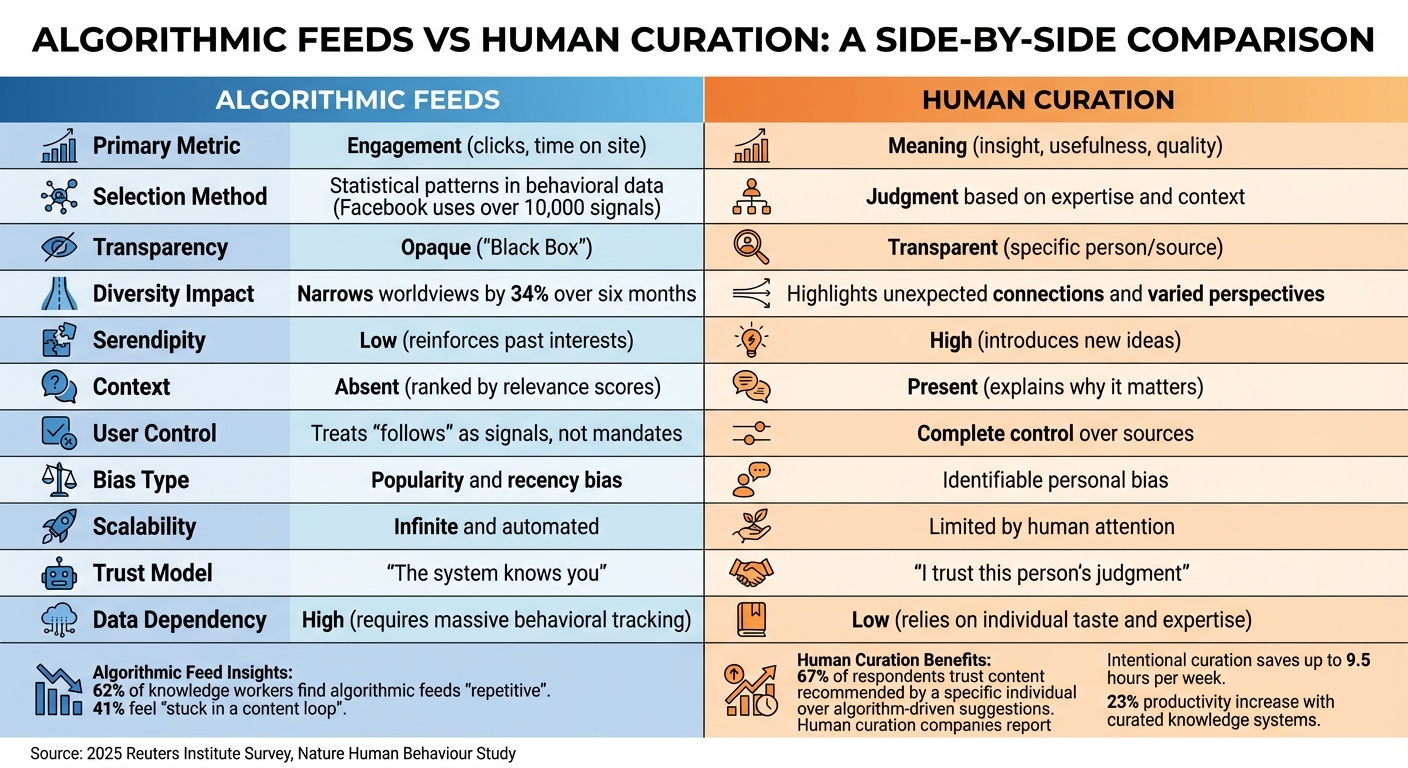
Algorithmic Feeds vs Human Curation: Complete Comparison Chart
Side-by-Side Comparison
When you compare algorithmic feeds and human curation, the differences in user experience and outcomes become clear.
Here’s a breakdown of how these two systems stack up across key dimensions, from their goals to the level of control they offer users:
| Dimension | Algorithmic Feeds | Human Curation |
|---|---|---|
| Primary Metric | Engagement (clicks, time on site) | Meaning (insight, usefulness, quality) |
| Selection Method | Statistical patterns in behavioral data (e.g., Facebook uses over 10,000 signals) | Judgment based on expertise and context |
| Transparency | Opaque ("Black Box") | Transparent (specific person/source) |
| Diversity Impact | Narrows worldviews by 34% over six months | Highlights unexpected connections and varied perspectives |
| Serendipity | Low (reinforces past interests) | High (introduces new ideas) |
| Context | Absent (ranked by relevance scores) | Present (explains why it matters) |
| User Control | Treats "follows" as signals, not mandates | Complete control over sources |
| Bias Type | Popularity and recency bias | Identifiable personal bias |
| Scalability | Infinite and automated | Limited by human attention |
| Trust Model | "The system knows you" | "I trust this person's judgment" |
| Data Dependency | High (requires massive behavioral tracking) | Low (relies on individual taste and expertise) |
This comparison highlights how algorithmic feeds and human curation cater to different priorities. Algorithmic systems often aim to maximize engagement, leveraging vast amounts of behavioral data. In contrast, human curation focuses on delivering content with purpose and context, often leading to more meaningful user experiences.
Recent data supports this. A 2025 Reuters Institute survey revealed that 67% of respondents trust content recommended by a specific individual they follow more than algorithm-driven suggestions. This suggests that while algorithms are designed to keep users scrolling, curated content resonates on a deeper level by prioritizing quality and relevance.
Eric Feng, former CTO of Hulu and Flipboard, offers an insightful perspective on this balance:
Boosting, restricting, ranking, and recommending content in algorithmic feeds may be the only way that social media can find balance and deliver the content experience that users want.
The Case for Intentional Feed Curation
How Human Curation Supports Digital Minimalism
Switching from algorithm-driven feeds to human curation is all about taking back control of your attention.
Did you know that 80% of global workers deal with information overload? This constant barrage of content hurts productivity and decision-making. On top of that, our average attention span has shrunk to just 8.25 seconds. Human curation offers a way out. By carefully selecting a limited number of information sources - like the 15-person limit in Fifteen - you can break free from the endless scroll. Scott H Young, a well-known learning expert, puts it into perspective:
Modern feeds work perfectly as a Skinner box on a variable reinforcement schedule: the content is mostly junk, but the occasional gem keeps you pecking the button for more.
Intentional curation doesn’t just free you from mindless scrolling - it saves time, too. In fact, it can reduce the time spent searching for meaningful content by up to 70%, giving you back about 9.5 hours every week. The rise in paid newsletter subscriptions also highlights this shift; people are increasingly willing to pay for thoughtfully curated content rather than settling for engagement-driven algorithms.
But there’s more to it than just saving time. This approach also helps sharpen critical thinking and encourages independent thought.
The Impact on Independent Thinking
Human curation’s benefits go beyond simplifying your digital life - it also helps you think in new and unexpected ways.
Algorithmic feeds tend to reinforce your existing habits and viewpoints, narrowing your perspective. A 2025 study in Nature Human Behaviour revealed that AI-powered recommendation systems reduced users’ exposure to diverse ideas by 34% over just six months. In contrast, curated feeds encourage you to explore different viewpoints and make connections across disciplines.
For example, curators often link seemingly unrelated topics, like blending calligraphy with technology, sparking fresh ideas and expanding your perspective. This approach not only inspires creativity but also boosts productivity. Workers who rely on structured, curated knowledge systems are 23% more productive than those who depend on traditional search methods. And let’s not forget the time savings - those reclaimed 9.5 hours per week give you room for deeper, more meaningful work.
Cal Newport, author of Digital Minimalism, explains this well:
Solitude requires you to move past reacting to information created by other people and focus instead on your own thoughts and experiences.
By cutting out the constant noise of algorithmic feeds, curated content creates the mental clarity needed for focused, reflective work.
The numbers back up this trend: RSS readers saw a 38% jump in active users between 2023 and 2025. It’s clear that more people are seeking intentional, curated ways to manage their digital lives.
Conclusion: Choosing the Right Approach
Deciding between algorithmic feeds and human curation isn’t about declaring one outright better - it’s about understanding what you’re prioritizing and what aligns with your needs.
Algorithmic feeds offer convenience and scale, bringing you content you might otherwise overlook. In fact, algorithms determine over 90% of the online content you encounter, and YouTube’s recommendation system alone drives 70% of the platform’s total watch time. But this ease comes with trade-offs. Algorithms often prioritize engagement above all else, which can compromise your privacy and distract you with endless streams of content, not always meaningful.
On the other hand, human curation requires more effort but provides unique advantages. Whether you’re using RSS feeds, newsletters, or tools like Fifteen, you’ll need to actively manage your sources. Yet, the rewards are compelling: greater control over your attention, reduced information overload, and more room for thoughtful engagement. Studies suggest intentional curation can save up to 9.5 hours per week and increase productivity by 23%.
Think about your goals. If you’re after effortless entertainment or broad discovery, algorithmic feeds might be your best bet. But if you value mental clarity, focus, and meaningful content, human curation is worth the extra effort. The shift toward curated content is growing - evidenced by a 50% year-over-year rise in paid newsletter subscriptions in 2025 - as more people opt for quality over quantity.
Ultimately, it boils down to choice. Balancing the ease of algorithms with the intentionality of curation is at the core of digital minimalism and independent thinking. The most important step? Be deliberate about your decision. Don’t let platforms dictate how you spend your attention - take control of it yourself.
FAQs
How can I tell if my feed is algorithmic or curated?
An algorithmic feed is designed to adapt in real-time to your activity. It learns from your behavior, inferred interests, and how you engage with content, often prioritizing posts that are personalized or likely to grab your attention. On the other hand, a curated feed - especially one managed by humans - usually sticks to a fixed, chronological order, free from algorithmic adjustments.
A quick way to tell the difference: If your feed shifts based on your interactions, it’s likely algorithmic. But if it stays consistent and follows a predictable order, it’s probably curated.
How do I escape a “content loop” without missing important updates?
To escape the endless cycle of repetitive content while staying informed, try switching to intentional, human-curated content sources. Tools like RSS feed readers are a great option - they show updates in reverse chronological order and skip algorithmic interference. Take control by carefully selecting trusted sources to follow, reviewing them periodically, and setting dedicated times to check for updates. This approach helps you steer clear of endless scrolling and focus on content that truly matters.
Can I combine algorithms with a chronological, human-curated feed?
Yes, it’s entirely possible to merge algorithms with a chronological, human-curated feed. Research shows that this hybrid model works well. Here’s why: algorithms excel at personalization, using vast amounts of data to tailor content to individual preferences. Meanwhile, human curation brings editorial judgment that can provide a broader, more thoughtful perspective.
Some platforms even go a step further by integrating editorial oversight directly into the algorithmic process. This creates a balanced system where automated recommendations are enriched with human input or organized chronologically. The result? A content experience that feels both precise and personal, while still maintaining a human touch.
Build your feed on your terms. Try Fifteen →
See also: Why 15 People Is Enough — the case for human-curated limits.
See also: The Fifteen Manifesto — the case for human-curated feeds.